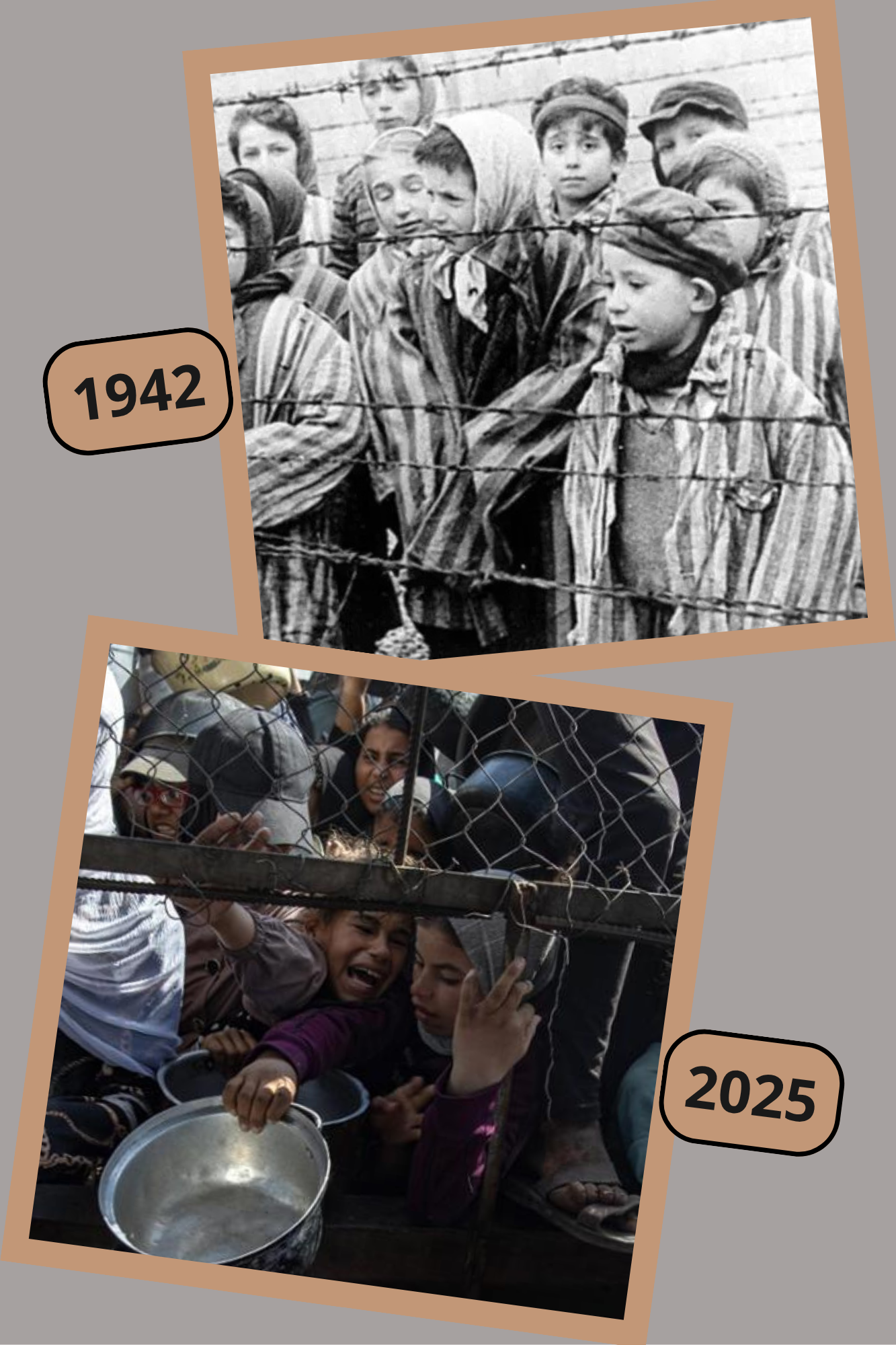
Alekos Hernández – July 26, 2025
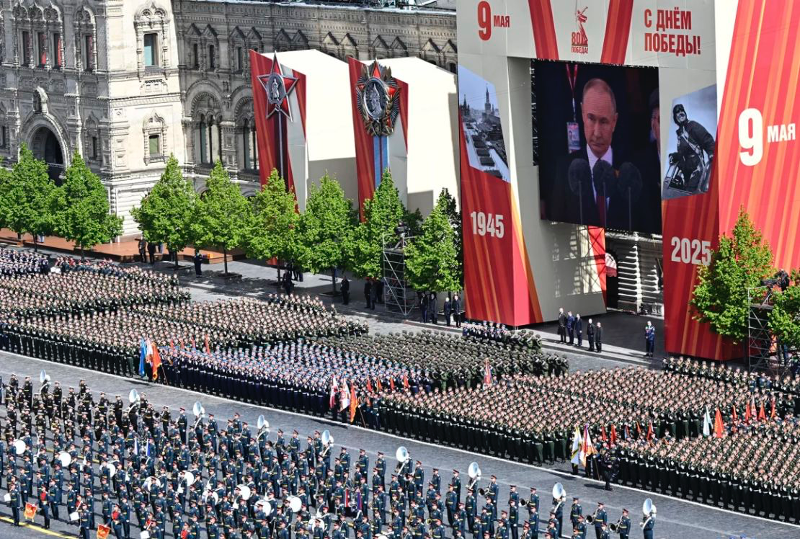
In May of this year, from London to Moscow, events were held to commemorate eight decades since the military defeat of German Nazism by the Allied armies (the United States, the United Kingdom, and the USSR). In honor of the historical truth of the men and women who sacrificed their lives for this victory, many of these commemorative events not only offered a distorted narrative of the past but also a brutal reflection of current interests. The 80th anniversary of the Allied victory over Hitlerian Germany has been celebrated by Western bourgeoisies as a clean, uncritical account, where the central role would have been exclusively played by the United States, the United Kingdom, and France. In this carefully constructed narrative —with a clear political intent— the crucial role of the Soviet working class and the Red Army in defeating Nazism, at the cost of more than 20 million lives, has been deliberately erased.
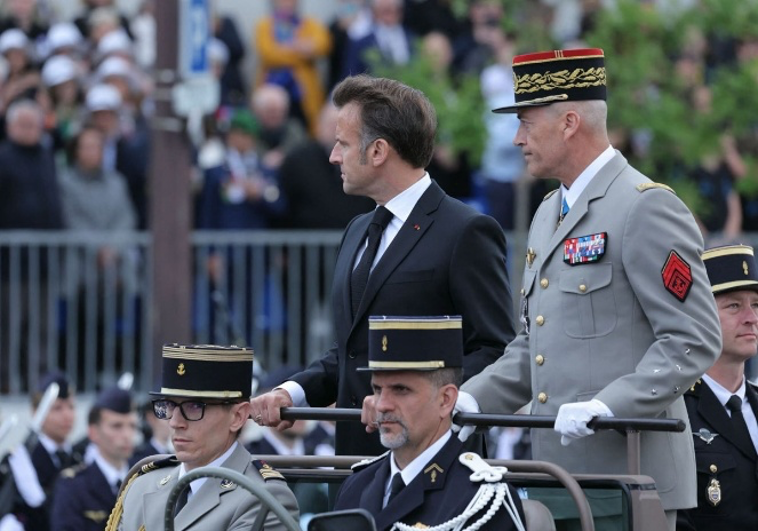
The symbolic exclusion of the «Soviets,» even as a historical category, is not a simple oversight but an active and conscious political and ideological operation. Today, as the inter-imperialist conflict between NATO and Russia intensifies through Ukraine, the imperialist victors are rewriting history to fit their geopolitical needs. Thus, what was a resounding democratic victory of the workers has been turned into a moral epic serving to legitimize current imperialism.
At the same time, sectors of the reformist and Stalinist left have also participated in these commemorations, but from a position equally functional to forgetting. Instead of recovering the revolutionary power of the international working class, which, in military uniform and armed with weapons, achieved a democratic victory in 1945, they have opted for an uncritical glorification of the USSR’s role, presenting Stalin as an unquestionable hero and burying any debate about the bureaucratic degeneration of the Soviet worker state and its betrayal of the world revolution with the initial agreement between Nazi Germany and the Soviet Union (August 23, 1939), which led to the almost victorious Nazi invasion of the USSR and its theory and policy of “socialism in one country.”
Thus, from seemingly opposite shores, both Western imperialism and reformist and Stalinist currents work to bury the living memory of the class struggle that ran through the Second World War.
As Marxist revolutionaries, it is essential for us to recover a class and internationalist perspective on the 80th anniversary of the end of the Second World War in Europe. For this is not merely a dispute over the past, but a fight for the present and the future of the struggle against capitalist barbarism expressed in environmental degradation, wars threatening nuclear catastrophe, and the genocide of the Palestinian people before the indifferent and complicit eyes of world rulers.
The Use and Abuse of the Term «Fascism»: Between Ideological Confusion and Political Functionality
It is for this reason that, in today’s globally polarized political landscape, the term «fascism» has returned to the center of debate, although often emptied of its historical and theoretical content. Different political sectors —from institutional leftists to other so-called progressive currents— frequently resort to this category to refer to any form of authoritarianism, conservatism, or even political antagonism.
This “inflation” of the term not only distorts its original meaning but also obscures the understanding of real political and class processes that generate it. Historically, fascism, born in Italy, was a violent counterrevolutionary reaction from capital to the direct threat of proletarian revolution. It emerged as a petit-bourgeois mass movement, mobilized from below by sectors of big capital to crush, through terror, the independent organization of the working class. It was a phenomenon specific to the interwar period, marked by economic crises, the decomposition of bourgeois democracy, and defeats resulting from the betrayals of the Stalinist and reformist leaderships of the working class.
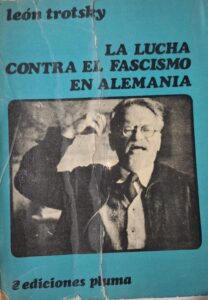
León Trotsky, founder of the Red Army, saw that:
“The essence and role of fascism is to completely liquidate all workers’ organizations and prevent any rebirth of them. In developed capitalist society, this objective cannot be achieved by simple police means. The only way to accomplish it is to oppose the pressure of the proletariat — when it relaxes — with the pressure of the petit-bourgeois masses driven to despair. It is precisely this particular system of capitalist reaction that has entered history under the name of fascism.”.[1]
Sin embargo, hoy vemos cómo, en contextos muy distintos, se etiqueta de «fascista» cualquier expresión de derecha radical, nacionalista, o incluso conservadora. Muchas veces sin un análisis de su base social ni de su relación con el capital.
However, today we see how, in very different contexts, the term «fascist» is applied to any expression of radical right-wing, nationalist, or even conservative politics, often without an analysis of its social base or its relationship with capital. In Colombia, for example, within the sector of Petroism, the term has been abused to disqualify opposition sectors, including those representing traditional right-wing or far-right groups, such as Uribism. While these currents may assume authoritarian, repressive, or reactionary positions, they do not constitute a fascist project in the strict sense. President Gustavo Petro does not miss an opportunity to categorize his political opponents’ actions or proposals as Nazi or fascist indiscriminately. Comparing disparate events, he stated: “What the ‘chulavitas’ did in the mid-20th century, when they carried out the first political genocide in the Americas: the murder of the liberal Gaitánist people, that time under the speeches of Franco, Mussolini, and Hitler, for which the Conservative Party has not apologized to the Colombian people, was fascism,” asserted the head of state.
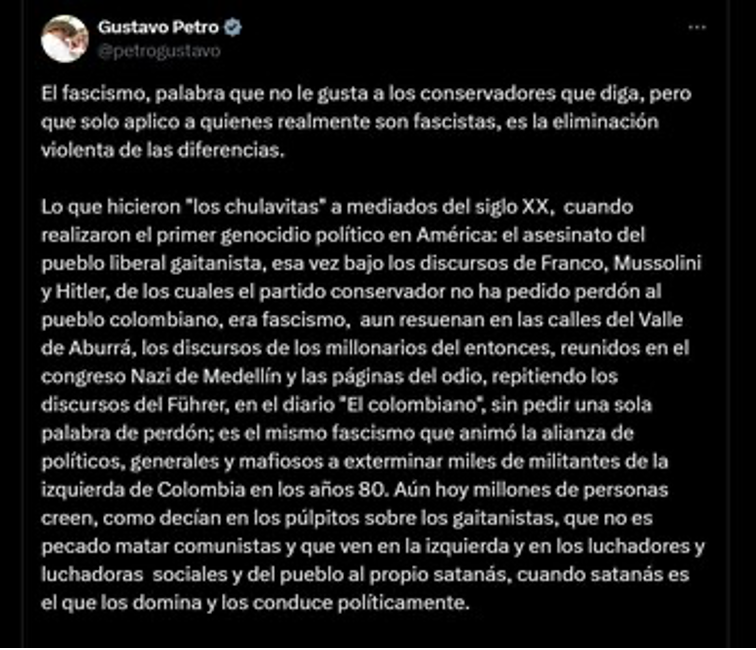
Petroism, like other so-called “progressive” currents in Latin America, uses the term «fascism» instrumentally: it is used to rally forces around their class conciliation project and present themselves as a “democratic” barrier to a supposed imminent fascist threat.
In reality, this use and abuse of the concept serves several purposes: first, to neutralize criticism from the left: by categorizing any criticism —even from revolutionary or classist sectors— as part of «fascism,» Petroism and generally left-wing governments and their supporters block political debate, seeking to silence the possibility of an independent, class-based alternative.
The second purpose is to legitimize alliances with sectors of capital: invoking «anti-fascism» as a supreme value justifies collaboration with supposedly «democratic» bourgeois sectors, thereby reinforcing a strategy of political pacts and electoral coalitions with the historical oppressors of the working class. And finally, it depoliticizes the social conflict: by turning the conflict into a struggle between «democracy vs. fascism,» it obscures that the real antagonism is between capital and labor. Both Petroism and its right-wing opponents, being spokespeople for different branches of the same capitalist class interests, do not represent a favorable way out for the exploited majority, for the workers.
Thus, the careless use of the term fascism not only generates ideological confusion but also serves a political function: to prevent and sabotage the development of independent class consciousness and strengthen the illusion that the institutions of the bourgeois state —parliament, elections, judges, courts, armed forces, etc.— can be tools for progressive transformation. Against this view, it is necessary to reclaim a Marxist understanding of fascism and the struggle against it: not as a defense of liberal democracy, within a narrow national perspective, as the majority of left-wing and progressive currents do today, but as part of a revolutionary strategy seeking the defeat of authoritarian governments and regimes in the course of a democratic struggle, with the perspective of mobilizing for the seizure of workers’ power and the construction of workers’ socialism with democracy.
The Military Defeat of Nazism: A Resounding Democratic Victory of the International Working Class
The defeat of Hitler, German and European Nazism in May 1945 marked the end of the Second World War in Europe, after six years of one of the most brutal conflicts in modern history. Hitler’s regime, which had come to power in 1933 with the support of significant factions of German capital, rapidly expanded across Europe, devastating countries and exterminating millions of people — particularly Jews, communists, gypsies, and political dissenters — in its imperialist and racist «Lebensraum» project. Its destruction was undoubtedly a momentous historical event and a resounding democratic victory of the international working class. The defeat of the counterrevolutionary Nazi regime opened up a colossal mass upsurge worldwide — in Europe and in the colonial world — that fueled the decolonization process and achieved fundamental victories such as labor rights and social security for workers after the end of WWII. Had Nazism not been defeated, the history of the working class and the peoples of the world would have been very different. Therefore, with due differences, defeating Israeli Nazi Zionism today is a primary task.
We all know from academic historiography that the protagonists of the military defeat of Nazism were the Allies (on one side, the Western imperialist powers led by the United States and the United Kingdom, and on the other, the Soviet Union). What is rarely mentioned —and this is evident in the various commemorations of the 80th anniversary of the Nazi defeat— is the fundamental role played by the Soviet working class, whose population and army bore the brunt of the war effort on the European continent. In fact, it was the Red Army that inflicted the most decisive defeats on Nazism on the Eastern Front, such as the Battle of Stalingrad (1942-43) and the final offensive on Berlin in 1945. These victories cost the Soviet people more than 20 million lives, a heroic display of working-class and popular resistance.
The entry of the United States and the United Kingdom into the war did not respond to a supposed altruistic defense of democracy against totalitarianism, but rather to their own imperialist interests. It was only when the Nazi advance threatened the global balance of capital and control of the markets — and when the possibility of communist revolutionary expansion grew in Europe — that the Western powers decided to intervene forcefully.
In other words, the war was not simply a crusade for freedom as it is often portrayed, but a conflict between imperialist blocs for influence and dominance — like the First World War — and simultaneously a deeply counterrevolutionary attack aimed at destroying the Soviet Union, which participated from a distinct and antagonistic position, despite already being deformed by the Stalinist regime, in combination with a confrontation and struggle between two politically oppressive and exploitative regimes, different and opposed.
Nazism, Fascism, and Bonapartism from a Trotskyist Perspective
From revolutionary Marxism, and particularly Trotskyism, the analysis of fascism is not reduced to a moral category or a label to disqualify political enemies. It is a specific political-social phenomenon, with a mass petit-bourgeois base in ruin, actively mobilized by big capital to physically crush the organized working class. In the words of Leon Trotsky:
“Fascism is not simply a system of repression, violence, and terror. Fascism is a specific system of the state, which rests on the annihilation of all elements of proletarian democracy within bourgeois society.”
(Where is France going?, 1934).
In this framework, Nazism can be understood as a particular form of fascism, developed in Germany with a strong racist component and an ideology of national and racial supremacy, but at its core, it served the same counterrevolutionary role: to physically destroy workers’ organizations, impose state terror, and guarantee the survival of German capital in crisis.
In contrast, Bonapartism, also analyzed by Trotsky, is a form of authoritarian domination by the bourgeois state that does not rely directly on a fascist mass movement but instead arbitrates between warring classes, concentrating executive power and partially suspending democratic forms, without completely destroying workers’ organizations.
Moreover, it is a reactionary expression of a crisis of hegemony rather than a total counterrevolutionary offensive with scorched-earth tactics. Governments like De Gaulle’s in France, or even certain Latin American regimes like Peronism at specific moments, have been characterized as Bonapartist, with marked differences due to their respective statuses as metropolitan countries, as in the first case, or semi-colonial countries, as in the second.
Nevertheless, we can outline some similarities and differences:
Similarities and Differences:
-
Both fascism and Bonapartism emerge in contexts of profound crisis of the bourgeois regime.
-
Both seek to halt and/or crush the independent mobilization of the working class.
-
Fascism achieves this by mobilizing reactionary masses from below; Bonapartism does so from above, through the state apparatus.
-
Fascism physically annihilates workers’ organizations; Bonapartism represses brutally but may tolerate them under control or subordination.
The Risk of Theoretical Confusion
Using the term “fascism” lightly to refer to any form of authoritarianism, conservatism, or state repression — as is primarily done by Stalinism and many reformist, progressive sectors — not only trivializes history but weakens the fight against the real counterrevolution, which has not only authoritarian expressions but also reactionary democratic ones, very pernicious. By placing deeply distinct phenomena on the same plane, the specific nature of fascism as a weapon of capital used in extreme moments is lost.
This confusion has serious practical consequences for workers and the peoples of the world: it leads to justifying as inevitable and “progressive” misguided tactical alliances (for example, with supposedly «democratic» capitalist sectors), it prevents the development of class independence policies. Most importantly, it obscures the fact that the real defense against the barbarism capitalism leads us to is not in the bourgeois state or its institutions or coalitions with bourgeois political sectors, but in the independent organization and mobilization of the working class and its own power.
At a historical moment when reactionary forces are resurfacing, and where authoritarian governments are proliferating that are not necessarily fascist, revolutionary Marxism must reclaim political and conceptual precision. Not as an academic exercise, but as a strategic necessity in the struggle against all forms of oppression, exploitation, and counterrevolution.
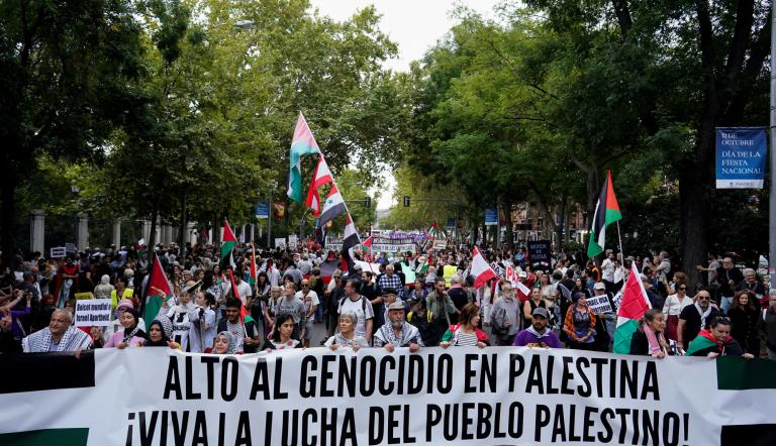
The greatest objective fact at this historical moment of the resurgence of reactionary forces in various parts of the world and the counterrevolutionary offensive like the genocide of the Palestinian people. The Ministry of Health of Gaza reported on July 13 the new total death toll in the Gaza Strip. The chilling number reaches 58,026, adding the Palestinians who died in the last 24 hours. Desperate, survivors are pleading for a ceasefire, but the ethnic cleansing and Palestinian extermination continue. In an article published on September 30, 2024, in this same portal (link here), we pointed out:
How to define these methods used by Zionism in Gaza, Lebanon, and Yemen?
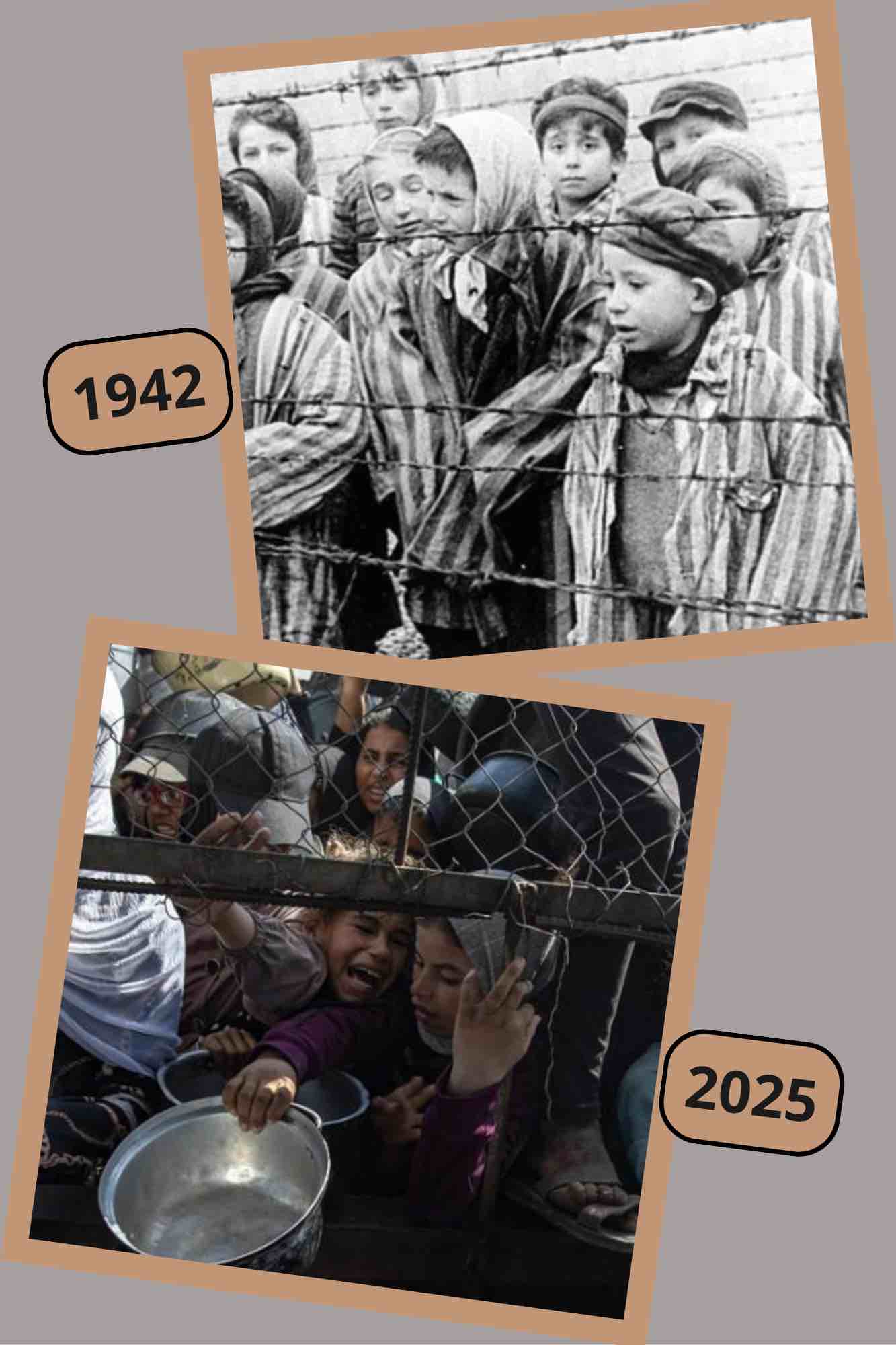
Using famine as a weapon of war; attacking the defenseless population in their homes and hospitals; systematically murdering health personnel; intentionally destroying schools and hospitals, as well as infrastructure that supplies water and energy, along with bombings that have taken the lives of thousands of women and children and reduced all cities in Gaza to rubble, are genocidal actions aimed at dispossessing the Palestinians of their lands and homes, inflicting pain and increasing suffering to decimate and demoralize the entire population and thus suppress any impulse they may have to resist the occupation.
The atrocities of Zionist actions are the modern expression of Nazi barbarism and the capitalist system in its stage of imperialist decomposition, which once again demonstrates that «where there is capitalism, Nazism is just around the corner if not stopped by the mass movement.»[2].
For the mass killings, death by starvation, and ethnic cleansing of the Gaza territory, along with horrific barbarism, as well as the overwhelming support from a large majority of the Israeli population for the genocide carried out by their army, we characterize this as a new Nazi-Zionist Holocaust.
Nazi, due to its racist component and its ideology of national supremacy (the chosen people of God). And Zionist due to the nature of the state of Israel and the political current led by its Prime Minister Benjamin Netanyahu, in open collaboration with the supply of weapons and resources from the U.S. and the European Union, within a framework of complicity from the remaining powers and almost all the governments of the world.
For a Revolutionary Strategy to Defeat the Authoritarian Offensive and Conquer True Workers’ Democracy
Eighty years after the military defeat of Nazism, history is once again in dispute. Today it is undeniable that we are facing a new wave of Nazi attacks led by Netanyahu (Israel) and authoritarian regimes and governments. For example, some cases include: Trump (USA), Viktor Orbán (Hungary), Giorgia Meloni (Italy), and despotic governments like Putin’s (Russia) or the Chinese rulers. In Latin America, Nayib Bukele (El Salvador), Milei (Argentina), Noboa (Ecuador), Boluarte (Peru), and with marked differences, but with authoritarian and deeply repressive traits such as Nicolás Maduro (Venezuela), Daniel Ortega (Nicaragua), and the Stalinist rulers in Cuba.
The ruling classes rewrite the past to legitimize their present, hiding the role of the working class in that victory and masking the interests of the imperialist victors. At the same time, the real dangers facing the peoples of the world today — from the strengthening of the extreme right to the hardening of authoritarian regimes — are addressed with confused or distorted categories, to prevent workers and youth from forging a political strategy that matches the current challenges.
From a revolutionary Marxist perspective, it is essential to unmask the current expressions of fascism, Nazism, and Bonapartism as distinct phenomena, but all in service of preserving a capitalist system in crisis, which can no longer guarantee even the most basic rights conquered in the past by popular struggle. The growing militarization of the state, the criminalization of social protest, hate speech and exclusion, racism, institutional patriarchy, and imperialist plundering of natural resources are not anomalies, but integral parts of capitalism in its decadent, imperialist phase.
For this reason, it is not enough to abstractly defend «democracy.» Bourgeois democracy, when it existed, was always limited, conditioned by the rules of capital. But even its most restricted forms — civil rights, freedoms of organization, suffrage, press, protest — are historical conquests won by the masses with struggle and blood. Defending them against any authoritarian offensive must be a top priority for the working class. But not as an end in itself, but as part of a strategy to go further: toward the defeat of authoritarian regimes and Nazi genocide, in the path of conquering workers democracy, workers self-organized power, and collective control of the means of production, in a new society governed by the working class.
In this context, the task is not to idealize the past nor to make pacts with sectors of the capitalist order to stop their more aggressive wings. Nor is it to hand over our flags to those who, like reformism or Stalinism, confuse the defense of democratic freedoms with humanitarian pleas and renunciation of revolutionary struggle. The only realistic way out is through class and mass mobilization, internationalist, deeply anti-capitalist.
All those who do not accept resigning themselves to a world of exploitation, war, and barbarism are called to organize politically to build a revolutionary and independent alternative as the working class. To defend democratic conquests against capitalist attacks, but above all, to go further: for a new power based on the democracy of the oppressed, in internationalist socialism, and in the overcoming of capitalism as a system. History has not ended; the class struggle remains open.
[1] León Trotsky. The Struggle Against Fascism.
[2] Nahuel Moreno (https://opcionmarxistainternacional.com/ataques-terroristas-de-israel-en-libano-y-genocidio-en-palestina-expresion-moderna-del-barbarismo-nazi/).