H. Klement – 24 -10-2025
Although more than a month has passed and the major media outlets have already moved on from what happened in Nepal, its repercussions are still being felt—in massive actions with similar results in Madagascar and in protests in Morocco, Peru, Ecuador, and other countries. While the media and social networks portray it as dissatisfaction limited to “Generation Z” and its “symbols,” the spread of the protests is explained by the miserable living and working conditions faced not only by young people but also by their families, as well as by growing poverty and lack of a future. For beyond facing different governments and specific national conditions, young people and broad sectors of the population in all these countries suffer the consequences of the same system that dominates them: capitalism.
To illustrate, see the following videos:
Nevertheless, due to its depth and scope, this article will focus specifically on what happened in Nepal.
A popular and youth-led insurrection topples the government
In just two days, and with astonishing speed, a youth- and popular-driven insurrection—through massive and militant mobilizations—overthrew Nepal’s government. Prime Minister Khagda Prasad Sharma Oli and much of his cabinet fled the country, evacuated by the Army in helicopters.
On September 8, thousands of large-scale demonstrators, organized mainly by students and young people of the so-called Generation Z (between ages 15 and 30), carried out a spontaneous, independent, and massive action that toppled the governing coalition of liberal bourgeois parties together with the Unified Communist Party of Nepal (a merger of a Maoist party and a Stalinist one)[1]—that is, a bourgeois government of class collaboration.[2]
The ban—just four days earlier—on platforms such as WhatsApp, Facebook, X, Instagram, and YouTube became the spark (or Colombia’s “El Florero de Llorente”) that detonated years of accumulated frustration and anger among the population. The ban was especially provocative because social networks are not just entertainment for young people; they are essential for tourism (Nepal is home to the Himalayas) and for communication with relatives working abroad, whose families depend on remittances.
According to the press:
The ban sparked fears that freedom of expression for Nepal’s 30 million inhabitants was being restricted and harmed a key industry—tourism— which depends on social media to reach travelers. The shutdown also isolated about two million Nepali migrant workers from their families abroad. Nepal’s economy depends heavily on the remittances sent by these workers.[3].
The ban ignited a long-suppressed discontent over the regime’s authoritarianism, the ostentatious wealth of government officials and their families, and blatant corruption.
This was captured as follows:
Monday’s protests were sparked by a digital movement that had been gaining momentum for weeks: the “Nepo Kid” campaign (from nepotism and kid), aimed at the children of politicians and influential figures accused of living off corruption. It gained major traction on social media. “Nepo Kids show off their lifestyle on Instagram and TikTok, but never explain where the money comes from,” said a user on TikTok.[4]
The popular insurrection—completely justified—was met with brutal repression, militarization of the capital and other cities, and the killing of at least 51 protesters [5] with over 1,000 wounded, according to The Kathmandu Post.
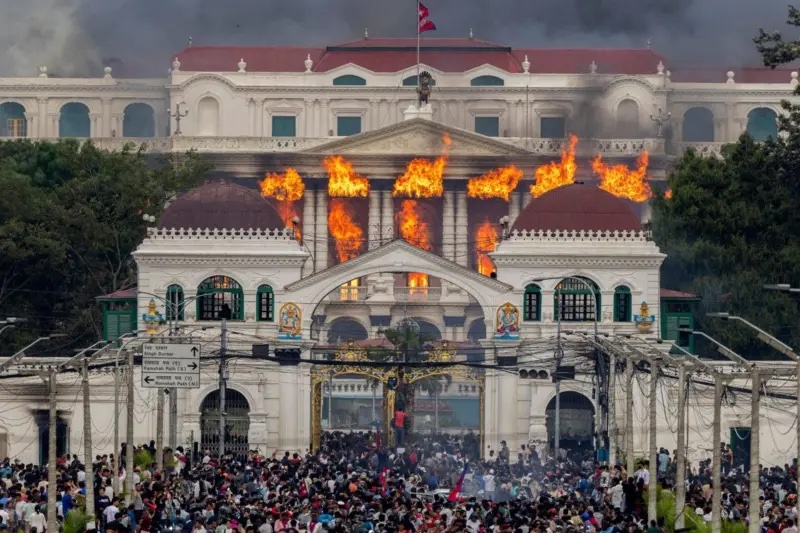
But the demonstrators did not retreat. The struggle intensified, leading them to break the police cordon around Parliament in the capital, storm the building, and set it on fire. The presidential residence, homes of other politicians, and the Prime Minister’s residence—burned with his wife inside—met the same fate. Major world media immediately condemned this “violence by the oppressed.”
As stated earlier, it was this independent mass action that, in just 48 hours, brought down the hunger-driving government and sent its leaders fleeing. The scale of the crisis and the power vacuum created by the mass mobilization were revealed in the swift reaction of the ruling elites, who—relying on the army—sought negotiations with youth movement leaders. Just three days later, they appointed former Chief Justice Sushila Karki as interim prime minister[6]. Forced by events, the elites sought to channel the deep political and social crisis and prevent its continuation.
The roots: poverty, unemployment, and inequality
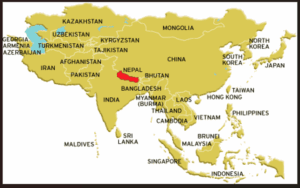
Nepal, a country in Asia nestled between China and India, has around 30 million inhabitants with a per-capita income of roughly $1,450 per year (about $400,000 Colombian pesos per month). Thus, the background of the protests lies in the intense poverty of the working people and the complete lack of opportunities for youth—contrasted with the plunder of the country by U.S., Chinese, and Indian multinationals, and the luxurious lifestyles of “communist” political leaders, their children, and their families.
The main commercial partners—i.e., the powers that oppress and exploit Nepal—are India, China, and the United States. The arrival of their capital investments, along with an IMF agreement signed in 2022, deepened misery and unemployment.
Media outlets highlight:
Today, hundreds of thousands of Nepali youths are forced to seek work abroad. In Gulf countries, Nepali workers are among the most exploited and cheapest. Those who cannot emigrate survive only on remittances. This is a stark reflection of a broken capitalist economy and hollow political structures.
Besieged by inequality and unemployment, most young people feel frustrated and without a future. Youth unemployment reached 20% last year (World Bank). About 7.5% of the population works abroad and depends on remittances. These are the fundamental causes of Nepal’s social discontent, which has persisted since the protests that abolished the monarchy in 2008—though the leaders of that process prevented a decisive break with dependent capitalism.
This grim reality forms the roots of the recent events, summarized by the following well-known reflection:
Extraordinary conditions, independent of the will of individuals or parties, must arise to break the chains of conservatism and push the masses into insurrection… The masses do not enter the revolution with a preconceived plan for a new society, but with a clear sense that they can no longer endure the old one.[7]
From our point of view, Nepali youth and broad sectors of the population refused to continue enduring the old society… for extraordinary conditions pushed them into insurrection.
A regional context of instability
The events in Nepal are part of a political and social earthquake shaking the region. A similar insurrection toppled Sri Lanka’s president in 2022. Two years later, a mass uprising overthrew Bangladesh’s government.
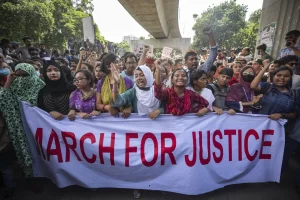
In Bangladesh, student protests began over limits on merit-based civil service posts, then turned into a massive national uprising last July that ended with the removal of Prime Minister Sheikh Hasina… In Sri Lanka, Prime Minister Ranil Wickremesinghe took power after protesters ousted the powerful Rajapaksa clan in 2022.[8]
Nepal’s uprising is thus not an isolated bolt from the blue. It is part of a deeper process of revolutionary actions by the masses within the country, and it unfolds in a regional context marked by large-scale upheavals that have toppled several oppressive governments aligned with global powers.
It also takes place within an international environment of rising global outrage over the genocide in Gaza and growing solidarity with the Palestinian cause—through strikes, boycotts, and massive mobilizations. Meanwhile, youth and other sectors are protesting against their governments across Peru, Madagascar, Morocco, Ecuador, the Philippines, France, Italy, and more.
A REVOLT OR A REVOLUTION?
Neither the late lifting of the social-media ban, nor the curfew, militarization, brutal repression, police cordons around Parliament, nor the UN’s “humanitarian” appeals for calm managed to stop the mobilization. All of this was overcome by the movement. Rather than halting the struggle, these measures pushed it forward—culminating in a spectacular triumph: the overthrow of the hated capitalist government.
Yet major media—and unfortunately, many organizations that claim to be “left” or even revolutionary—have described the events merely as a “revolt” or a “social explosion,” similar to those in Colombia and Latin America in 2019–2021.
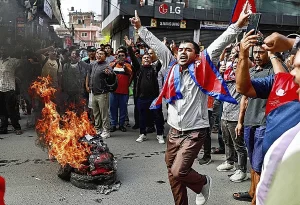
To minimize or hide the victories won by the masses is a crucial task for ruling classes everywhere—supported by imperialist powers, their media, and political tendencies hostile to mass struggle. Their aim is to prevent the mobilization from deepening and to halt the dynamic development underway—like the one in Nepal—thus preserving the decaying system. To do so, if necessary, they will make major concessions—“giving up the rings to keep the fingers,” or even the fingers to save the hand.
Therefore, beyond superficial similarities with past social explosions, it is essential to define precisely what the masses accomplished in Nepal. This is decisive for those who support the heroic mobilizations and seek to prevent their derailment.
We recognize that all processes share common features but also have their own specific characteristics. If this were truly just a simple ‘uprising’ or ‘social outburst,’ very similar to those led by youth and popular sectors in Chile, Ecuador, Colombia, or elsewhere, then its actions, duration, and outcomes would also be very similar. However, a careful and objective analysis makes it clear that Nepal stands apart.
How did it unfold?
Nepal’s youth placed themselves at the head of the mobilizations of the working population. They did not isolate themselves, nor did they act as small groups of radicalized activists detached from the masses—as seen in other uprisings, which often led to deaths, mutilations, injuries, and imprisonment.
Instead, Nepal’s youth led the masses in confronting repression and militarization with mass methods, defeating both. Their strength prevented demoralization. The triumphant result: the government fell in just two days.
Their fundamental political orientation was clear: to mobilize consistently and militantly to topple the government. Unlike in some uprisings where activists focused solely on denouncing corruption, police brutality, or human-rights abuses—or, as in Colombia, using social media to promote “peace negotiations” with guerrilla groups.
The rapid and forceful dynamic also prevented opposition politicians from using the deaths and injuries to call for suspending the struggle [9] or warning that toppling the government would cause a “military coup”—as Petro did in Colombia.[10]
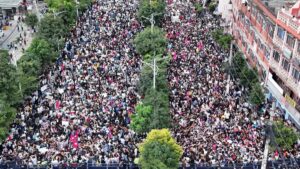
Within the framework of these crucial differences between the processes, we nevertheless find important similarities in the politics and behavior of the trade union leaders. Both in the uprisings in Latin America and, for different reasons, in those in Nepal, union leaders—rather than bringing their members into the struggle against the government—kept them on the sidelines. In the uprisings in Colombia, Chile, the United States, or Ecuador, despite being in opposition to the governments, they prevented the working class and wage earners from joining the process. In Nepal, they acted this way because they were completely bound by their political support for the government. There will also be similarities in the political solutions they promoted during the uprisings and those many union and political leaders in Nepal will now promote: seeking to drown discontent at the ballot box and cut short the mobilization process by directing youth and the population to place their hopes in elections, in parliament, and in the rest of the establishment’s institutions.
However, beyond these similarities and minor differences, for us the fundamental distinction lies in the fact that what occurred in Nepal was an abrupt political shift—unplanned by anyone, sudden and overwhelming. A shift that opened an entirely different reality from the one that existed in the country just days before, altering the relationship between the ruling class and the youth and the masses.
One day the government boasted of its achievements, enriched itself openly and without restraint, its children flaunted their luxury and privileges, and politicians delivered fiery speeches in parliament—and in a matter of hours, all of that was reduced to ruins by the action of the masses in struggle. [11] Ultimately, this is because a revolt or a social uprising is one thing, and a triumphant revolution, as an objective fact, is something entirely different. And that assessment, for us, is to a great extent independent of the significant limitations or political unawareness of its protagonists, of the social actors involved, and of the process that followed.
A TRIUMPHANT REVOLUTION
We therefore have no doubt in characterizing the deep process in Nepal—built over years—as an extraordinary revolutionary process that achieved a major victory by overthrowing a class-collaborationist bourgeois government.
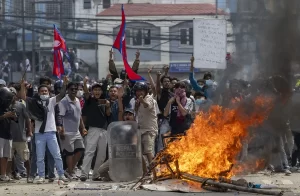
Within some revolutionary socialist organizations, however, there are those who seem to argue that it would be misguided to define what happened as a revolution, since the social order did not change—that is, power did not pass from one social class to another—and because the ruling class was not expropriated; or because the state’s armed forces or the political regime were not dismantled; or even, going further, because such a definition would only apply if the process were led by a revolutionary Marxist party and if the working class acted as the social subject at the forefront.
Some even claim that one must not ‘confuse mobilizations or the fall of governments with actual revolutionary transformations.’ They therefore argue that a mass action capable of toppling a bourgeois, exploitative, oppressive, and imperialist-aligned government would not constitute an ‘actual revolutionary transformation.’ What would it be, then? A transformation carried out not through revolutionary means but through reformist ones? And ‘not actual,’ meaning not real, nor true? For them, the ongoing process in Nepal did not, in practice, challenge the existing social order and the power of the State. For us, it did—and it did so as a profound revolutionary process, though marked by the major limitation or contradiction of being an unconscious one.
We acknowledge that in this case the armed forces were not dismantled; nor did power shift from one social class to another; nor was it a process led by the working class and a revolutionary Marxist party—that is, it was not a conscious process, as in the case of the Russian Revolution of October. In truth, none of this took place.
But the fact that reality does not conform to those important criteria should not prevent anyone from objectively assessing what happened and determining whether, for the youth, the popular masses, and the working people, this was merely a heroic struggle with seemingly limited scope—one that does not open a new and profound political process in the country. Or perhaps whether it does not represent a serious setback for the system of domination, oppression, and plunder imposed on the country by the imperialist powers (the U.S. and China) or by regional powers such as India.
Recognizing what the mobilization of the youth and the masses accomplished is vital. Internally, it meant the sudden destruction of a significant part of the institutional framework of domination and oppression upheld by the exploiting classes, delivering a decisive blow against them. And externally, it dealt a blow to their partners and sponsors—the imperialist powers (the U.S., China, India, etc.) that profit from the misery and labor of the country’s great majority. Bringing down a government that serves imperialism creates a new front for the U.S. and the other powers, and objectively helps, even if indirectly, the masses of the world and the cause of the Palestinian people in their resistance against Zionist genocide.
It is essential to ask what the hundreds of thousands of Nepali youth—those plunged into misery and forced to migrate to countries where they are considered cheaper and more exploitable labor—think today about what happened and about having brought down the government. Do these young people and working-class communities believe they are now witnessing changes of little relevance to their lives and working conditions? Do they see it as the result of a fleeting uprising? Do they think that shattering the structure of domination, oppression, corruption, and ostentation of the political elites, and removing the government from the scene abruptly and decisively, is something of little importance to their lives? Or merely the outcome of some short-lived ‘outburst’? And what do the families of the young people who were killed or injured think?
From our perspective, the change that took place in Nepal is so remarkable that it requires an objective definition of its significance. However, it must be emphasized that our characterization of what occurred is made in relation to the government and the bourgeois institutions. Key institutions of domination—such as Parliament—were completely demolished through revolutionary methods and in a sudden manner, rather than through mild or peaceful protests advancing reformist demands—what is now commonly referred to as ‘the street’ (sic). If we stick to the facts and not merely to prior theories, what happened in Nepal aligns with the idea that ‘Insurrection represents the most critical and intense moment in the struggle between two classes for power… [and] …Precisely the active intervention of the masses in events is the main element of revolution.’[12]
That is, at the national level, we are not speaking of a proletarian and socialist revolution like the October Revolution in Russia, but rather of an objectively revolutionary process that is nonetheless affected by the absence of a proletarian and revolutionary leadership. This will seriously impact it in the medium and long term, but it does not invalidate the action of the masses as a real process, nor the revolutionary methods through which they succeeded in toppling the government.
To delve deeper into why we call these phenomena a revolution, we refer to the fact that what occurred contains elements similar to the following description:
“The most indisputable feature of a Revolution is the direct intervention of the masses in historical events. As a rule, the State—whether monarchical or democratic—stands above the nation; history is made by specialists in the field: monarchs, ministers, bureaucrats, parliamentarians, journalists. However, at decisive moments, when an old regime becomes intolerable for the masses, they tear down the walls that separate them from the political arena, sweep away their traditional representatives, and by intervening in this way, create the starting point for a new regime. Whether this is good or bad is for moralists to judge. As for us, we take the facts as they unfold in their objective development. For us, the history of a revolution is, first and foremost, the account of a violent irruption of the masses into the spheres where their own destinies are shaped.”
(Leon Trotsky, Introduction to The History of the Russian Revolution, 1932).
Thus, for us in Nepal—and in other countries—we seek to take the facts as they are presented. We recognize that, since the old regime became intolerable for the masses… they tore down the walls that separated them from the political arena… and… overthrew their traditional representatives…
And we fully agree with the statement that a revolution… is, initially, the account of a violent irruption of the masses into the spheres where their own destinies are shaped…
This is why it becomes essential to appreciate the entirely progressive course that has opened up in the reality of the youth and the most impoverished sectors of the population. It represents an immense leap forward in their understanding of what they are capable of achieving through their struggle. This does not change simply because a new battle begins—one aimed at definitively putting an end to oppression, exploitation, and dispossession. A battle against those who seek to sabotage it, betray it, and force it onto the sterile terrain of the ballot box. Against the leaders of the establishment parties and/or their agents within trade unions and popular organizations.
The effort to grasp the depth of real events is an invaluable tool for correctly interpreting what has happened and for orienting oneself properly, without losing the class political compass—so blurred today for so many.
For our part, we base our political action on the conviction that this possibility of independent and consistent mobilization must be allowed to break through. We place our hopes in the mobilization and direct action of the working class and the youth, for their needs and demands—once again postponed, as in Nepal, by the illusion of class-collaboration governments alongside politicians and parties that defend capitalist interests and fail to decisively break with the domination of the major powers.
BOXED NOTE
Left-wing governments: a dead end
In Nepal, the youth and the masses brought down—through their revolutionary action—a bourgeois class-collaboration government: a political alliance between the false “communists” of the Unified Communist Party of Nepal and a liberal bourgeois party. A Stalinist-bourgeois government. One more among the many governments today that wrap themselves in a red flag and call themselves “left-wing,” only to administer capitalism, enrich themselves through it, and protect it from the pressure of the working people and the masses by preventing them from going further and advancing toward a workers’ and popular government.
This revolution in Nepal therefore also exposes the dead end produced by the politics and program of “left-wing” parties that bet on coexistence or cohabitation with politicians and sectors of the country’s traditional ruling classes. They present such arrangements as supposed solutions to poverty, unemployment, youth marginalization, oppression, and state violence. This is the reformist policy of organizations that, for that purpose, label seasoned traditional bourgeois politicians as “progressive” or “anti-neoliberal.”
The failure of this bourgeois ‘left-wing’ government—which today has bitten the dust in Nepal due to the action of the masses—is in some ways similar to its counterparts in Argentina, Bolivia, Venezuela, Peru, Ecuador, and elsewhere. The difference lies in the fact that the failures of those governments were electorally capitalized by the far right and the pro-imperialist bourgeois right. In other words, those conciliatory governments paved the way for political regression. Not so in Nepal, where instead of a setback, society and the process were driven forward—precisely because it was not the result of elections or parliamentary maneuvering, but of extra-parliamentary action: the direct and decisive revolutionary mobilization of the youth and the working people.
This is a path that conscious youth and workers could pursue in the face of the frustration and disillusionment caused by the ‘left-wing’ governments in Colombia, Brazil, Chile, or Mexico. It is imperative to advance beyond these failed reformist experiences, rather than allow political regression and the return of the most reactionary sectors of bourgeois parties and politicians.
Where, as we have witnessed, young people, workers, and the poor are condemned to the sad role of serving only as an electoral reservoir for alliances with business politicians—partners and agents of the transnational interests of foreign powers. This, instead of resorting to backroom deals, secret agreements, and electoral arrangements with politicians and parties of the traditional bourgeois establishment.
[1] https://elpais.com/internacional/2025-09-09/nepal-levanta-la-prohibicion-a-las-redes-sociales-tras-las-protestas-que-han-dejado-19-muertos-y-400-heridos.html
[2] A ‘Stalinist-bourgeois’ government, according to the old definitions of our international current: ‘a type of government that emerges under conditions of extreme weakness of the bourgeoisie… which, through the mediation of Stalinism, has defended and developed the national bourgeoisie while maintaining the forms of bourgeois property.’ Correo Internacional, Year II, No. 9; January 1985.
[3] https://www.nytimes.com/es/2025/09/10/espanol/mundo/nepal-protestas-que-pasa.html
[4] Ídem.
[5] https://www.infobae.com/america/mundo/2025/09/12/ascendio-a-51-la-cifra-de-muertos-en-nepal-tras-los-violentos-disturbios-que-provocaron-la-caida-del-gobierno/
[6] https://www.dw.com/es/nepal-confirma-30-muertos-tras-la-oleada-de-protestas/a-73955282
[7] TROTSKY, Leon – The History of the Russian Revolution, Volume I, p. 8. Pluma, Santafé de Bogotá, 1982.
[8] https://www.infobae.com/america/mundo/2025/09/10/tres-revueltas-en-cuatro-anos-como-fue-la-abrupta-caida-de-los-gobiernos-de-nepal-sri-lanka-y-bangladesh/
[9] https://www.infobae.com/america/colombia/2021/06/09/gustavo-petro-rechazo-los-bloqueos-viales-y-dice-que-siempre-ha-convocado-a-manifestaciones-pacificas/
[10] YouTube, Petro’s Address, May 16, 2021.
[11] In the face of the Storming of the Bastille, Louis XVI asked: ‘Is this a revolt?’ ‘No, Sire, this is a revolution,’ they replied.
[12] Trotsky, Leon. In Defense of October (What Was the Russian Revolution?) Lecture delivered on November 27, 1932.