By: Virginia B. October 2025
INTRODUCTION
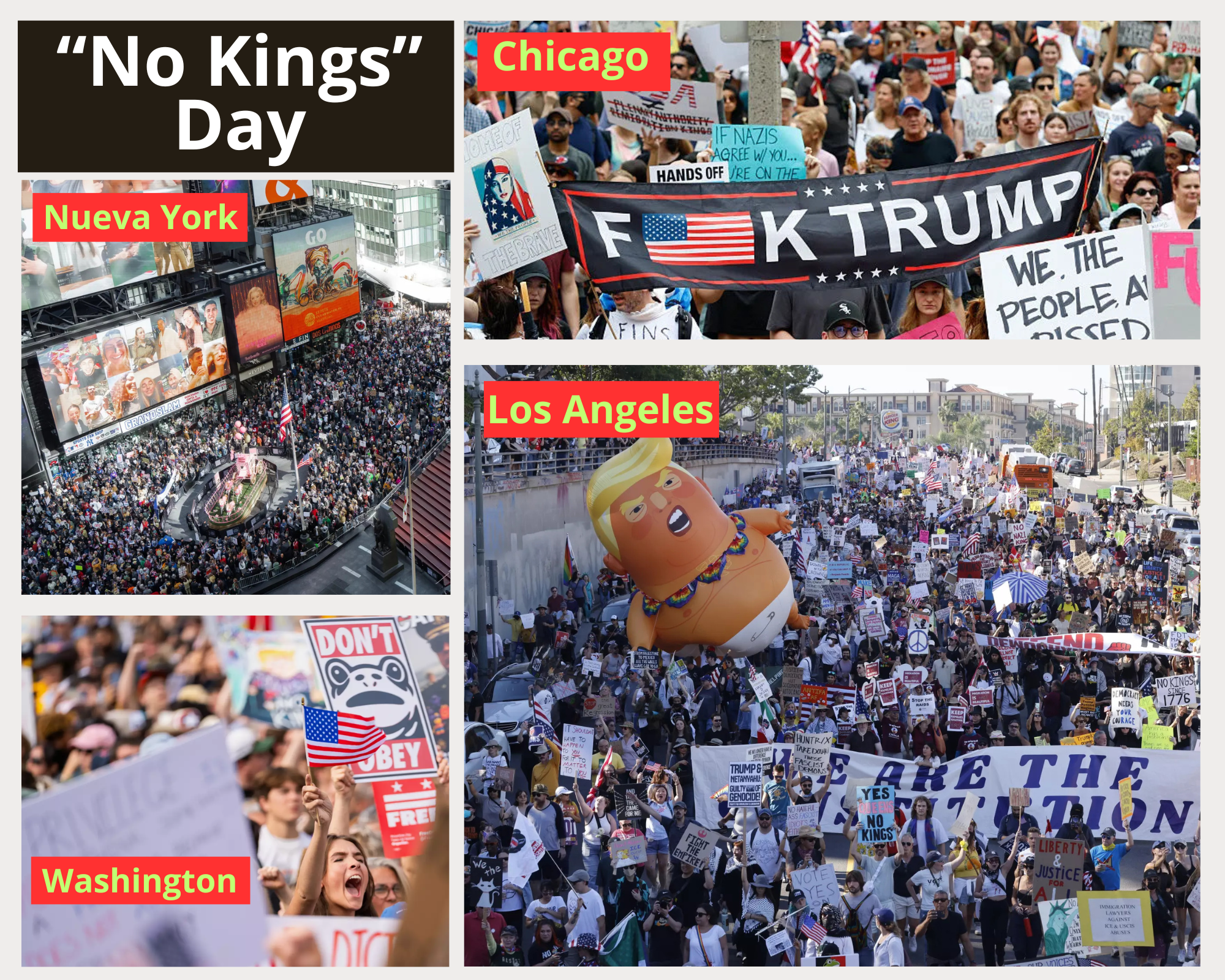
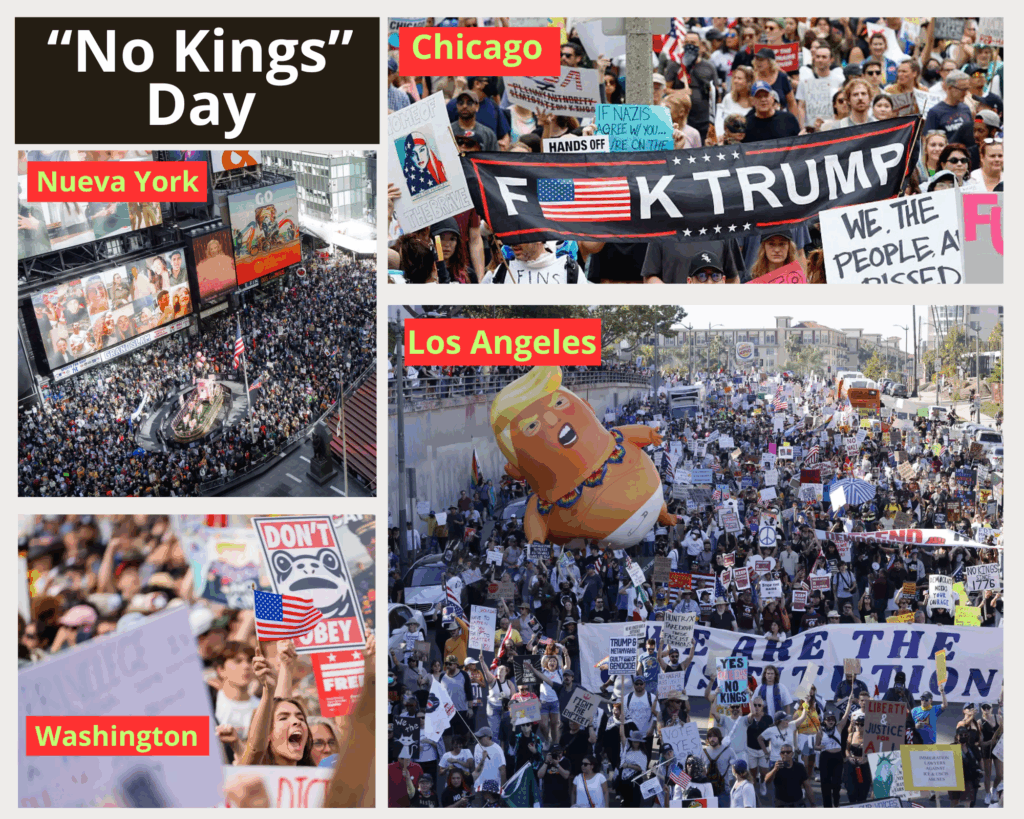
The recent mass mobilizations under the slogan “No Kings,” which flooded the streets of more than fifty U.S. cities, mark a new chapter in the resistance against the authoritarianism of the Trump government. This second national “No Kings” day, following the first one held on June 14, 2025, together with the massive “Hands Off” demonstrations of April 5, constitute a strengthened continuation clearly expressing the magnitude of the struggle against the direct threat represented by Donald Trump. In just ten months since his return to power, the president has revealed his firm decision to systematically and unrestrainedly attack the most basic democratic rights of the U.S. population. Under the openly authoritarian—bonapartist—rhetoric of “restoring order” and “making the nation great again” (MAGA), his administration has promoted repressive policies that undermine civil, political, and social rights won over decades by broad popular sectors.
These mobilizations did not arise out of nowhere. They are part of a process of resistance that has been building since the historic protests against racism after the murder of George Floyd, and which today regains strength in the face of the government’s attempts to establish a permanent state of exception. What is happening today in the streets of the United States is the reaffirmation that, even in the heart of imperialism, the masses are not willing to give up the rights and gains wrested through decades of struggle.
Although Trump’s offensive has unfolded on all fronts—political, economic, and labor—both nationally and internationally, this article will focus on the attack on democratic freedoms, which has had a profound impact on U.S. workers and the masses. [See also: ¿Qué Expresa La Nueva Elección De Trump?].
However, it is essential to emphasize that this offensive is not partial, but rather an integral and global attack whose purpose is to intensify oppression and consolidate social control. Ultimately, the aim of the imperialist bourgeoisie is clear: by repressing and attempting to quell resistance mobilizations against democratic attacks, it seeks to pave the way for deeper exploitation, extending its offensive into economic and social rights—wages, housing, employment, and health. In short, the democratic question is inseparably linked to the economic question.
In such a short time, this new regime has done what it could not achieve during its previous term, intensifying attacks against immigrants, imposing mass raids, militarized detention centers, and forced deportations, even of individuals with legal residency. Simultaneously, it has unleashed a campaign against the LGBTQ+ community, rolling back legal protections, promoting discriminatory laws, and censoring expressions of identity in educational and cultural spaces. Universities have been direct targets of this offensive, with attempts to restrict freedom of speech and academic freedom, and to criminalize student protest.
The Trump administration has also pushed setbacks in reproductive rights, reintroducing highly restrictive anti-abortion policies and undermining women’s right to decide over their bodies[1]. Added to this is an aggressive campaign against freedom of the press and expression, labeling journalists, critical media, and activists as “enemies,” and fostering a climate of censorship and persecution.
We also see a direct attack on the scientific community, the health sector, and the fight against climate change. Trump has drastically cut research funding, dismantled environmental agencies, and withdrawn the United States from international sustainability commitments. The regression is evident in the appointment of openly anti-science figures to his cabinet: such as Education Secretary Linda McMahon, a billionaire known for her fundamentalist and privatizing agenda, or the new head of the health department, Robert Kennedy Jr., a well-known anti-vaccine activist who has dismantled preventive vaccination and public health programs. In addition, there was the brief stint of Elon Musk at the Department of Government Efficiency (DOGE), where he launched a wave of mass layoffs, leaving thousands of health, human services, and other state-agency workers stripped of their livelihoods. [See also: With Trump: “Workers Under Attack”]
And completing this authoritarian offensive, Trump has launched a frontal attack on the very institutions of his much-praised bourgeois democracy, particularly the judiciary. He has imposed openly illegal decisions and even threatened to imprison judges who dare contradict him. Finally, in response to the just and forceful mobilization of broad sectors of the population against these measures, the president ordered the deployment of 700 Marines in the city of Los Angeles and the National Guard in Chicago and Washington, overriding legal challenges and appeals from state governors.
As noted, these measures have not gone unanswered by the U.S. masses. Mobilizations have multiplied across the country, and rejection of ICE (Immigration and Customs Enforcement) has grown, showing the regime that resistance is uniting in one voice and that its policies will not go unchallenged. [See also: Amid Chants of “Hands Off!” and “No Kings!”, Masses Rise Against Trump’s Policies]
This response from the masses is decisive in the face of the authoritarian and bonapartist project, with fascist traits, led by Trump. This regime, an expression of the decay of imperialist capitalism, seeks to dismantle the most basic democratic rights. For a deeper understanding of the concepts of bonapartism, authoritarianism, and fascism, we recommend the article “80 Years After the Defeat of German Nazism: We Witness the Genocide of the Palestinian People by Israeli Zionist Nazism!”, which explores these ideas in greater depth.
IMMIGRATION, RACISM, AND CRIMINALIZATION
Displacement and immigration have been fundamental to the origins of capitalism, allowing the bourgeoisie to count on a large industrial reserve army available to generate monumental profits. In the United States, immigration has shaped the nation’s demographics and culture, with a population drawn from many nationalities that expanded exponentially throughout its history. With this army of workers—disposable and deprived of rights—the great fortunes of families such as the Rockefellers, the Waltons, the Trumps, the Musks, and all the billionaires were built, enriching themselves at the expense of the most vulnerable through extreme exploitation.
Leon Trotsky noted that the formation of the proletariat and industrial expansion in the United States were deeply intertwined with migratory processes and the use of contracted labor under extremely harsh conditions. In his analyses of the “Black question” and U.S. society, he highlighted the massive proletarianization of workers as a structural factor of the economy (see Trotsky, The Black Question in the United States, 1933; Europe and America, 1926).
Simultaneously, bourgeois governments began to implement anti-immigrant laws that created a permanent atmosphere of pressure and criminalization, pursuing three fundamental objectives:
-
To create a framework that enabled the subjugation of immigrants to the most brutal working conditions, without trade-union or legal rights.
-
To maintain a layer of workers deemed “illegal,” used as an instrument to depress wages and erode the rights of the entire working class.
-
To encourage chauvinism and racism among the middle class and sectors of the native working class, thereby dividing the exploited to secure capitalist domination.
Through this lens, we can identify Trump’s current immigration policy—marked by raids, walls, forced deportations, and xenophobic rhetoric—which seeks to divert attention from the true enemy: the imperialist capitalist bourgeoisie and its system of exploitation.
[See also: “Trump: Crisis y ofensiva contra los pueblos del mundo”]
Since February 2025, the Trump administration has intensified massive raids in both urban and rural areas, deploying ICE agents alongside special units of the National Guard. In cities such as Houston, Chicago, and Los Angeles, the operations have targeted entire neighborhoods with high concentrations of migrant populations, carried out without judicial warrants and with excessive police force. In agricultural regions of California and Texas, Latino workers have been intercepted at their workplaces and detained without the possibility of appeal, generating a widespread climate of terror.
These operations have been justified by the government under the rhetoric of “restoring order” and “protecting the borders,” when in reality they constitute a systematic persecution of ethnically diverse communities. According to the Migration Policy Institute, more than 350,000 deportations were recorded in 2024 (https://www.migrationpolicy.org). However, during 2025, CNN reported that ICE has deported nearly 200,000 people in the seven months since Trump returned to office. [2]
At the same time, deportations have accelerated, even affecting migrants with legal residency or ongoing immigration processes. A symbolic case is that of the young Salvadoran Ángel Abrego García, who was deported and confined in Cecot, the mega-prison of the kneeling Salvadoran president Bukele — a facility notorious for violating even the most basic freedoms — despite the fact that Abrego had held permanent resident status for seven years. He was detained following a routine immigration appointment in New Jersey, without any legal hearing. Human rights organizations have reported similar cases in Florida, New York, and Nevada. Meanwhile, the government has announced the construction of new militarized detention centers, such as the one installed on the outskirts of Tucson, Arizona, managed by private contractors and with restricted access for independent observers, reinforcing the policy of mass criminalization and confinement of migrants.
The official discourse has evolved into openly xenophobic language, in which migrants are labeled as “internal enemies,” “infiltrators,” or “agents of chaos.” This narrative has had a devastating impact on Latin American, African, Arab, and Asian communities, who are facing an increase in hate speech and racist attacks. Since the beginning of the year, more than 200 incidents of verbal and physical violence against people of diverse ethnic backgrounds have been reported in public spaces, schools, and businesses. Statements by Trump himself and members of his cabinet — including the new Secretary of Homeland Security — have fueled this atmosphere, promoting a culture of reporting and denouncing neighbors and elevating white nationalism as a central pillar of their so-called “patriotic” agenda.
To illustrate the magnitude of the problem, some media outlets have circulated videos showing ICE’s violent tactics against demonstrators:
Despite the brutal advance of criminalization driven by the Trump administration, a growing unity among diverse sectors of the population has also become visible. Not only migrant communities, but also broad sectors of the native U.S. population —workers, students, neighborhood organizations, and activists— have begun to organize to confront the raids directly. In cities such as Oakland, Portland, and Minneapolis, multiple cases have been documented in which neighbors blocked ICE vehicles, preventing arbitrary detentions. This past July, a mass action in Brooklyn successfully stopped an arrest operation by surrounding the building and forcing the agents to withdraw. As one participant stated that day: “We are not going to allow them to tear our families apart. We will face them here.” These expressions of solidarity and resistance show the way forward: only the direct mobilization of the masses can stop these authoritarian policies and defend the most basic rights against the advance of the repressive project.
CENSORSHIP, EXCLUSION, AND PERSECUTION: FROM SEXUAL DIVERSITY TO ACADEMIC FREEDOM
“The working class does not defend bourgeois democracy as an end in itself, but it must defend without hesitation every democratic right — of organization, of expression, of assembly — because these are conquests wrested from the enemy that make it possible to prepare for its overthrow.”
(Leon Trotsky, The Transitional Program, 1938).
In Trotsky’s words the defense of democratic rights wrested from the bourgeoisie through struggle lays the groundwork for the masses to win far more than they currently possess. This is precisely why Trump seeks to set a precedent against this mass resistance. In particular, we highlight the offensive that simultaneously targets the LGBTQ+ community and the academic community. Both spaces, which have historically been centers of diversity, critical thought, and struggle for democratic rights, have now become principal targets of an authoritarian project aiming to impose cultural homogeneity and ideological control.
In the case of the LGBTQ+ community, anti-discrimination protections have been repealed in several states, content related to sexual and gender diversity has been banned in schools, and laws restricting civil rights such as marriage equality and adoption have been promoted. These setbacks have been accompanied by an increase in hate speech — supported by the government — which has fueled violent crimes against queer individuals and normalized exclusion in cultural and social spaces.
At the same time, universities are undergoing an unprecedented process of siege. Under the slogan of “restoring order and discipline,” restrictions have been imposed on academic freedom, curricula have been intervened, and student protest has been criminalized through surveillance, persecution, and arbitrary arrests on campuses. The country has regressed to prohibiting and censoring books and texts in hundreds of libraries. Some of the censored books, according to Martínez (2025), include An Indigenous Peoples’ History of the United States by historian Roxanne Dunbar-Ortiz — a critical account of U.S. history from the perspective of Indigenous peoples; Brave New World by writer and philosopher Aldous Huxley, which portrays a totalitarian society where artificial happiness is imposed through genetic manipulation and drug consumption; and No Truth Without Ruth by children’s author Kathleen Krull, among many others that reflect on history, identity, or various forms of social criticism.[3]
Critical educators have been harassed and dismissed, while activities related to the defense of diversity, democratic freedoms, and particularly the Palestinian cause, have been prohibited under accusations of “subversion” or “antisemitism.” In particular, the movement opposing the Zionist genocide in Gaza has been met with severe repression: hundreds of students have been expelled from their academic programs, arrested, and, in the case of some international students with legal status, deported without due process. This wave of punitive measures demonstrates the extent to which dissent — especially when it challenges U.S. imperial policy and its alliances — is being criminalized and framed as a threat to “national stability,” thereby eroding foundational democratic rights in academic spaces. This repression echoes earlier periods of political persecution in U.S. higher education, such as McCarthyism, where ideological conformity was enforced through surveillance, purges, and loyalty demands. Today, however, these measures are cloaked in the language of “security” and “anti-extremism,” masking their function as tools of political control.
In addition to the criminalization of student protest and the persecution of faculty, a financial form of coercion has been institutionalized: the suspension of federal funding to universities such as Harvard, Columbia, Princeton, and the University of Pennsylvania until they alter curricular content related to diversity, gender, or pro-Palestinian activism. This punitive mechanism seeks to enforce ideological conformity by leveraging economic pressure against academic institutions traditionally associated with critical inquiry and civic engagement.
More broadly, this offensive extends to a systematic attack on scientific research. Under the pretext of reducing public spending and “eliminating ideological influence,” essential funds for research and public universities have been cut, resulting in the paralysis of high-impact projects. These measures coincide with the dismantling of environmental agencies and the withdrawal from international climate agreements, thereby consolidating a public policy agenda that favors the interests of extractive and highly polluting energy industries. The combination of climate denialism and contempt for scientific inquiry powerfully illustrates the subordination of state policy to the priorities of these capitalist sectors, revealing a broader authoritarian trend that suppresses evidence-based decision-making in favor of corporate and ideological imperatives.
These measures are aligned with the Heritage Foundation’s Project 2025 initiative[4], which proposes the privatization of student lending and the dissolution of the Department of Education, thereby restricting access to higher education in line with nationalist and corporate interests. In doing so, the administration seeks to discipline academic institutions, constrain freedom of teaching and inquiry, and suffocate any remaining spaces for critical thought or social resistance.
What unifies these assaults is a deliberate strategy to impose a climate of fear and censorship. The administration aims to reassert the most reactionary conservative values of the ruling class and suppress the critical capacities of students and faculty alike, neutralizing universities as sites of dissent, intellectual autonomy, and collective mobilization. Ultimately, this represents an effort to dismantle democratic gains, reverse decades of progress, and eliminate autonomous spaces from which the regime’s authoritarian agenda could be challenged.
HEALTH AND SCIENCE UNDER SIEGE
The new Trump administration is composed of some of the most reactionary figures serving its political and corporate agenda. Anti-vaccine activists, ultra-conservative business leaders, and individuals aligned with Christian dominionist movements now occupy key positions of authority, resulting in the abandonment of vaccination and public-health prevention campaigns. These appointments are not administrative errors but elements of a deliberate strategy: replacing scientific evidence with ideological dogma that reinforces capital accumulation and political control.
Within this framework, public health has been severely weakened. Essential care programs have been defunded, and epidemic-prevention initiatives have been relegated to a secondary role. In addition, the administration has cut funding to community clinics and services for vulnerable populations, exposing millions to worsening health insecurity. These developments unfold in a country where healthcare was already profoundly unequal and market-driven, structured as a profit system for major insurance companies and hospital conglomerates. For working-class people, even the most basic forms of medical care remain inaccessible without exorbitant costs that lead to indebtedness or outright exclusion.
According to KFF Health News (2025), more than 1,500 community health centers serving millions of low-income individuals face imminent closure due to the suspension of federal funding. This situation is compounded by the cancellation of $11.4 billion in Centers for Disease Control and Prevention (CDC) programs related to vaccination and epidemic preparedness, a move that has already led to the closure of clinics in states such as Texas, Arizona, and Minnesota (Healthbeat, 2025).
This institutional collapse reached a critical point with the resignation of CDC Director Dr. Demetre Daskalakis[5], who declared in a public letter that he could no longer work “in an environment that treats the CDC as a political instrument rather than a scientific institution.” In the letter—published by outlets including The Guardian and Politico in October 2025—Daskalakis directly accused Trump and his Secretary of Health, Robert F. Kennedy Jr., of “distorting data, endangering children, pregnant women, and marginalized communities,” and concluded by stating, “it is time to stop turning public health into a political weapon.” Simultaneously, free clinics—which provide over six million consultations annually—operate under untenable financial strain with minimal state or federal support (STAT News, 2025).[6]
Parallel to these developments, the administration has launched an offensive against reproductive rights. Abortion criminalization has expanded even to cases of rape or life-threatening medical conditions, while the closure of specialized clinics has drastically restricted access to reproductive healthcare. This is not merely a moral debate; it is a political mechanism designed to re-assert control over women’s bodies, reversing gains secured through decades of democratic struggle.
If this trajectory continues, it will be working-class and marginalized communities—the most exposed and least protected—who will bear the consequences, paying with their health and their lives for policies that privilege profit and ideology over human welfare. Defending science, public health, and hard-won rights is therefore an urgent and essential task.
Freedom of the Press and the Judiciary Under Siege
The assault on press freedom constitutes one of the most visible expressions of the authoritarian direction of the Trump administration. Critical media outlets have been stigmatized as “enemies of the people,” community channels shut down, and international correspondents—such as those from the reputable Associated Press—expelled. Karoline Leavitt, the White House Press Secretary, epitomizes Trump’s authoritarian posture by publicly intimidating journalists from the presidential podium, sidelining critical outlets, and consolidating strict control over the national media sphere. These measures are accompanied by legislative initiatives aimed at regulating digital content and social media, as well as judicial harassment and the detention of independent journalists. The overarching goal is to impose a compliant media environment in which official propaganda displaces dissent, silencing critique and democratic debate.
Simultaneously, Trump has launched a direct offensive against the bourgeois legal order and the judiciary. Drawing on the ultraconservative Project 2025 program,[7]which, among other provisions, allows the president greater influence over certain prosecutors and investigators while they examine his cases, Trump seeks to fortify centralized executive control. The illegal dismissal of Lisa Cook—former economic adviser to Barack Obama and current member of the Federal Reserve Board—currently contested in court, illustrates this intent to install loyal figures in key institutional positions. Trump has issued unconstitutional executive orders without review, intensified public threats against federal and state judges, and advanced reforms to appoint sympathetic magistrates and remove adversaries, alongside approving a new electoral map that favors his party.[8]
This offensive culminates in a policy of internal militarization in response to social protest. The decision to deploy 700 Marines to Los Angeles—illegal and unprecedented since 1992—represents a dangerous escalation. Further, Trump has selected five predominantly Democratic cities for the deployment of the National Guard—Illinois, Oregon, California, New York, and Washington—under the rhetoric of “cities in chaos,” the “internal enemy,” and “domestic terrorism.”[9]In this context, social mobilization—including labor unions, community organizations, and public demonstrations—is criminalized, while new “public order” legislation restricts basic civil liberties. Consequently, all forms of collective struggle are reclassified as threats to “national security.”
Taken together, these attacks on the press, the judiciary, and the right to protest reaffirm a political project aimed at establishing a permanent state of exception, in which democratic freedoms are reduced to their minimum expression and repression becomes normalized as a governing practice. Such measures have eroded one of the fundamental pillars of the very democracy that those in power claim to defend. What emerges is a clear effort to subordinate the judicial system to executive authority, producing a scenario of concentrated power characteristic of authoritarian regimes with proto-fascist features.
Imperialist Offensive and Global Coercion
While this analysis has focused primarily on the domestic dimensions of the United States under the Trump administration, it is also necessary to briefly address its external orientation, which starkly reveals the nature of contemporary imperialism toward subordinated and semi-colonial nations. In Latin America, the revocation of Colombian President Gustavo Petro’s U.S. visa—along with those of several senior officials—and their placement on the Office of Foreign Assets Control (OFAC) sanctions list constitute a clear act of political intimidation. These measures punish a government that—however belatedly—has denounced the genocide in Palestine and criticized recent U.S. military actions in the Caribbean. Such actions exemplify coercive instruments deployed to discipline semi-peripheral states, reinforcing their subordination to Washington and reasserting the region’s status as the imperial “backyard.”
Simultaneously, the deployment of U.S. troops near the Venezuelan border represents an explicit threat of military intervention, whose underlying objective is to secure strategic control over Venezuela’s extensive energy resources and to impose a compliant administration aligned with U.S. interests. These developments form part of a broader strategy to deepen economic and political domination in Latin America, reshaping regional power relations in line with the priorities of U.S. capital.
(See: “NO TO U.S. MILITARY INTERVENTION IN VENEZUELA!”)
Likewise, in the Middle East, the Trump administration has intensified its complicity in the genocide in Gaza, providing political and military support to the Zionist regime in Israel while coordinating with Western powers and allied Arab governments to secure control over strategic transport corridors, natural resources, and Palestinian territory. For Trump, the signing of the so-called “peace agreement” represents a purported diplomatic victory; in reality, it constitutes an imposed settlement aimed at consolidating the colonial domination of the Palestinian people.
The plan envisions, among other measures, the annexation of a “security perimeter” in Gaza and the establishment of an ostensible “international force”—in practice, a new occupation apparatus or a proxy administration under the Palestinian Authority, subordinated to a structure controlled directly by imperial powers. (See: “STATEMENT: The Trump-Netanyahu “peace” plan for Gaza: A disgraceful imposition”)
Taken together with U.S. strikes against Iran and Yemen, these policies reflect a broader imperialist offensive of dispossession and subjugation intended to maintain U.S. hegemony amid the systemic crisis and declining legitimacy of its own capitalist order.
The Task of Workers in the United States and Across the World: The Anti-Imperialist Struggle
“Democratic freedoms are not concessions granted by the bourgeoisie but victories wrested by the masses. Defending them—even under the most reactionary regimes—is essential, for they are trenches from which the broader struggle against the system itself is prepared.” (Conversations with Nahuel Moreno, 1986)
Nahuel Moreno articulates with remarkable clarity the imperative of defending historical gains secured through mass struggle, emphasizing that the imperialist enemy will offer no respite in its pursuit of domination. Today, this adversary is embodied in the Trump administration, whose project seeks to consolidate authoritarian control over the working masses—not only domestically but as part of a broader global imperialist offensive, as noted previously. Its support for far-right figures across Latin America, Europe, and Asia illustrates its ambition to reaffirm United States leadership within the imperialist order.
In this context, international institutions such as the United Nations have once again revealed their structural alignment with imperial power. As Moreno asserted in Updating the Transitional Program (1980), “The UN and its specialized agencies are accomplices of imperialism. They are not neutral: they conceal interventions, military coups, and even genocides. They are a diplomatic masquerade designed to legitimize the policies of the major powers.”
[See also: “La ofensiva Colonizadora de Donald Trump-EEUU” ]
Accordingly, the only viable response to this escalation is unified, anti-imperialist mass mobilization—of workers, oppressed communities, and all those committed to democratic advancement. Such mobilization must defend the hard-won democratic rights that are now under threat, confronting this authoritarian and neo-colonial project. If this resistance converges with the burgeoning mobilizations inside the imperial core itself—most notably the “No Kings” movement—a historical horizon emerges: the articulation of a transnational struggle against the Trump regime both within and beyond U.S. borders.
Thus, the historical task before the working class globally is unmistakable: to unify the “No Kings” mobilizations with a broader anti-imperialist struggle capable of transforming indignation into organized power, reinforcing social resistance across nations. The defense of democratic liberties, opposition to militarization, and solidarity with oppressed peoples—particularly with the Palestinian people facing genocide—constitute inseparable fronts in a single struggle linking democratic resistance inside the United States with the global fight against imperialism.
Faced with rising bonapartism and reaction, the only path forward lies in unity, struggle, and continental mobilization of the working class—both within the United States and in pursuit of a second independence for Latin America. Only through this course will it be possible to halt the imperial offensive and open the road toward genuine emancipation: a workers’ state founded on democratic self-government.
Against the internal repression and external aggression of the imperialist Trump government:
UNIFIED ACTION TO DEFEND DEMOCRATIC LIBERTIES!
We call on labor leadership in the United States and Latin America to organize continental days of protest against the dismantling of rights and democratic freedoms!
One united cry across the continent:
No to U.S. political and military intervention!
Yankees out of Latin America and the Caribbean!
Neither Trump nor Netanyahu: Palestine will be free from the river to the sea!
[1] Véase artículo sobre políticas anti-aborto
[2] Artículo de CNN. Link: https://cnnespanol.cnn.com/2025/08/28/eeuu/ice-deportaciones-cifras-trax
[3] TArticle: “Borrar el pasado, controlar el futuro: los libros prohibidos del trumpismo”, del diario El País y luego publicado por www.msn.com/es. Link del art. completo – The Trump Administration Is Erasing American History Told by Public Lands and Waters
[4] Fuente: El Proyecto 2025 devastaría la educación pública
[5] Fuente: https://www.elmundo.es/ciencia-y-salud/salud/2025/08/28/68b0a6de21efa075248b456d.html
[6] KFF Health News. “Federal Funding Crisis Threatens Community Clinics.” KFF Health News, 2025: Link – Healthbeat. “CDC Program Cuts Close Clinics Across Multiple States.” Healthbeat, 2025: Link – Daskalakis, Demetre. Public letter of resignation. The Guardian and Politico, Oct. 2025: Link
[7] Fuente: El plan del Proyecto 2025 para la justicia penal de Trump
[8] Fuente: Mapa electoral favorable a Trump
[9] Fuente: Radiografía de las cinco ciudades demócratas que Trump ha elegido como laboratorio para combatir al «enemigo interior»