By: llie Pérez and Irene Idris. September 2, 2025
Military Deployment in the Caribbean: A Threat to Venezuelan and Regional Sovereignty
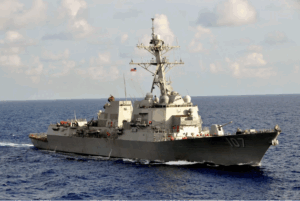
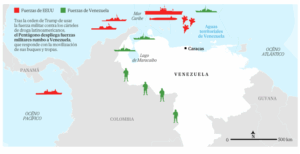
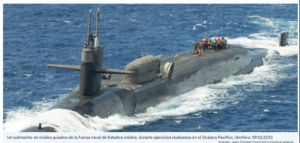
The United States has carried out a large-scale naval deployment in Caribbean waters off the coast of Venezuela. The operation includes warships, a nuclear submarine, more than 4,500 military personnel, 2,200 marines, and other weaponry with high destructive capacity.
The White House declared in a press conference: “To put an end to the Cartel of the Suns, all options are on the table—except ground invasion.” [1]
Although President Donald Trump justified this operation under the pretext of combating the so-called Cartel of the Suns, the real objective is oriented toward overthrowing the government of Nicolás Maduro or, failing that, forcing his resignation. This is because his administration, despite its authoritarian character, has remained politically independent from U.S. influence and dictates, thereby defying U.S. domination and keeping Trump’s hands away from Venezuela’s energy resources.
This scenario is compounded by the participation of France, another global power, which has reinforced its military presence in the islands of Guadeloupe and Martinique—territories it still holds under colonial administration. The French government has justified its intervention under the same pretext: “For France, this is a measure that forms part of an international cooperation strategy against drug cartels.” [2]
This military deployment, pointed directly at the Miraflores Palace, represents one of the most significant U.S. operations in Latin America since the invasion of Panama in December 1989, which culminated in the overthrow of General Manuel Antonio Noriega.
In light of this panorama, it is essential that the peoples of Latin America speak out firmly against this operation and against the attempts to delegitimize the government of Nicolás Maduro. No matter how questioned or discredited this government may be, such intervention constitutes direct interference in the internal affairs of a sovereign state and a grave threat to the sovereignty and self-determination of all nations in the region.
The Economic Interests Behind the Pretext of the “War on Drugs”
The argument of combating drug trafficking at sea—particularly the so-called Cartel of the Suns—actually conceals the economic and geopolitical interests motivating U.S. military intervention in the region.
The so-called “war on drugs,” subscribed to by most governments in what Washington considers its “backyard,” functions as a pretext to maintain, and even expand, U.S. military presence and domination in Latin America. Through this strategy, Washington seeks to secure greater control and subordination of the region’s countries in order to guarantee access to strategic natural resources, using the dispatch of advisors, missions, and specialized military brigades.
An obvious example is Colombia. In addition to the historic and privileged presence of U.S. troops on Colombian military bases, the so-called Cauca Mission and the Southern Command are currently operating, while construction advances on a new military base on Gorgona Island. The latter was presented by former Minister of the Environment and current presidential candidate, Susana Muhamad, as an “ecotourism project.” In practice, however, it represents a major concession to U.S. policy of expanding its control over the Pacific Ocean, within the framework of the geostrategic dispute with Chinese and Russian transnational corporations.
This process of deepening interference is supported by the current Colombian government. The administration of Gustavo Petro has facilitated the opening of the country to these operations while maintaining silence on Colombia’s NATO membership. Its defenders have also adopted an uncritical stance toward these policies of subordination.[3] [See also: “La ofensiva colonizadora de Donald Trump-EEUU”].
Furthermore, the so-called “war on drugs” also reflects an economic struggle among mafias in producing and exporting countries, connected to mafias within the United States itself. Ultimately, this is a dispute over the control of a highly lucrative business. According to Portafolio (2014):
“Drug trafficking moves US$ 320 billion annually. Organized crime represents 1.5% of global GDP. If it were the GDP of a country, this activity would be among the world’s 20 largest economies, roughly equivalent to the wealth produced by the Netherlands.” . [4]
Within the logic of the capitalist system, the production and commercialization of narcotics are conceived as commodities competing in profitability with other industries, such as arms production and trafficking, oil, or other minerals. Hence, the pursuit of profit prevails over any ethical or moral consideration.
Thus, U.S. strategy does not focus with equal intensity on combating consumption and drug trafficking networks within its own territory. Instead, it directs its offensive toward the periphery: cocaine-producing countries such as Colombia, Bolivia, and Peru, as well as money-laundering circuits operating through its financial institutions and consolidated at various points across Latin America. This is the economic backdrop of the aggression.
Regaining Political and Economic Control over Venezuela: A Crucial Issue for the U.S.
The current offensive against Venezuela, including the military siege in the Caribbean, primarily responds to Washington’s interest in reestablishing political and economic influence in the country—an influence lost since Hugo Chávez came to power. Added to this is the aim of controlling strategic maritime routes, gaining access to Venezuela’s vast biodiversity, and, above all, securing dominance over its enormous oil reserves, the largest in the world.
To achieve this, Washington requires the establishment of a compliant government subordinate to its interests, similar to administrations prior to chavismo.
On a broader scale, this policy is part of the global disputes over spheres of influence with powers such as Russia and, especially, China, which has consolidated itself as Venezuela’s main trading partner:
“According to 2022 data from the Observatory of Economic Complexity, China is the primary destination of Venezuelan exports (16.4%) and the main source of its imports (31.4%). In 2022, Venezuela sold China primarily petroleum derivatives and minerals valued at US$ 703 million, while it imported all types of manufactured products valued at US$ 3 billion.”
In addition, Chinese private investment in Venezuela’s energy sector is significant. As La República reported: “China Concord Resources Corp (CCRC) has begun exploiting two oilfields in Venezuela and plans to invest more than US$ 1 billion in a project to produce 60,000 barrels of crude oil per day by the end of 2026, said an executive directly involved in the project.”[5]
 In this context of dispute between the U.S. and other world powers for control of strategic resources and spheres of influence, the construction of the U.S. military base on Gorgona Island in Colombia gains special relevance, as part of Washington’s “maritime strategy.” This was confirmed by the article A ‘Military Base’ on Gorgona Island?, citing statements from General Laura Richardson, head of the Southern Command, who noted that Washington’s main concern is the growing involvement of its “principal rivals,” China and Russia, in Latin America (V-A., March 24, 2022).
Richardson has repeatedly explained her country’s vision:
“This region, she affirms, is rich in resources…. And our competitors and adversaries know it too… 60% of the world’s lithium is in this region. You have heavy crude, light crude… rare earth elements… the Amazon… 31% of the world’s freshwater… And there are adversaries who exploit this region, every day, right in our neighborhood. And I only see what happens in this region in terms of homeland security, in the United States.” (L.R., Aspen Institute Forum, July 20, 2022). [6]
Her words leave no doubt: behind the rhetoric of security and cooperation, the true motivation of the United States in Latin America is to guarantee control over vital strategic resources for its economy and maintain its hegemony against advancing rival powers. Meanwhile, the resounding declarations of the Petro government mask its subordination to these imperialist interests.
The Global Colonizing Offensive
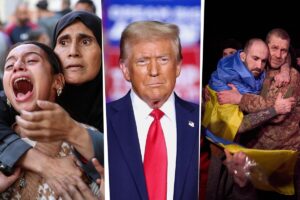
The attack against Venezuela is not an isolated event but forms part of a global colonizing offensive propelled by the international imperialist regime led by the United States. This dynamic manifests alarmingly and horrifically in the genocide against the Palestinian people in Gaza and the West Bank, perpetrated by Israeli Zionism. Concurrently, it is reflected in U.S. and Israeli aggression toward Iran, as well as bombings in Lebanon, Yemen, and Syria.
Domestically, the United States is also carrying out an offensive aimed at dismantling historic democratic and labor gains as never before. This is evident in the persecution of immigrant workers and the ferocious attack on the working class. As noted in one of our publications:
“This wave of layoffs and privatizations has decimated the employment of thousands of wage-earners, not to mention eroding industrial safety and increasing occupational risks. A veritable ‘labor massacre’, as it is said in Colombia.” [See: With Trump: Workers Under Attack]
In sum, in this context of expanding economic and geopolitical interests, the objective of the United States is to reestablish its domination over Venezuela, reinforce its control in the region, consolidate its presence in the Pacific Ocean, and secure command over the maritime routes of the Atlantic and Caribbean.
Hence, the current military encirclement and the latent threat of military intervention or invasion against the Venezuelan people are embedded in this broader global strategy of domination.
The Militarization of Caribbean Waters: A Threat to Regional Sovereignty
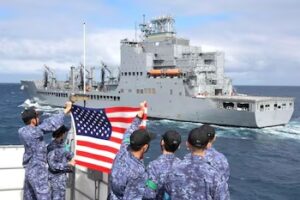
While the presence of U.S. warships in Caribbean waters is primarily directed at Venezuela, this deployment constitutes a direct aggression against the sovereignty of all Latin America. Far from being limited to a single country, it affects the region as a whole—even when several governments subordinated to Washington openly support it.
An example of such subordination is Panama’s president authorizing U.S. warships to transit through the Canal toward the Caribbean, along with the unconditional support expressed by the governments of Javier Milei (Argentina), Dina Boluarte (Peru), and Nayib Bukele (El Salvador)—lamentable pawns of Trump’s strategy.
The Ministry of Defense of Colombia backs the intervention, while President Petro considers it a “mistake.”
Statements from Colombia’s Minister of Defense following the U.S. deployment in the Caribbean against Venezuela represent a shameful endorsement of the operation. [7]
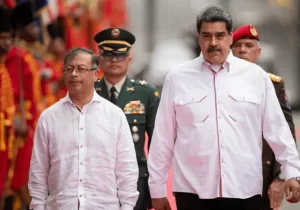
Meanwhile, the President of Colombia, after declaring that military intervention would be “a mistake,” and without directly addressing his minister’s remarks, affirmed via the social network X that, “Latin American and Caribbean problems are solved by Latin Americans and Caribbeans.”
While these statements are relevant, they are woefully insufficient given the gravity of the situation. They urgently need to be supplemented by a call to the broadest unified mobilization of the peoples of Latin America—without exception. It is vital to recall the Latin American response to the English aggression in the Malvinas (Falklands), which serves as an example of common resistance against foreign interference.
Only through such unity will it be possible to successfully confront any U.S. attempt to depose Maduro and to halt the pressure currently being exerted against him, demanding the immediate withdrawal of the U.S. deployment near Venezuelan shores.
Only thus can the principle of national sovereignty and the right of peoples to full autonomy over their territory, resources, government, and political system be defended in a real, effective, and consistent manner—free from external interference, subordination, or conditioning. It is imperative that both Gustavo Petro and other regional leaders labeled as “left” move from declarations to action, to practical supportive solidarity with the brother country.
Support for the Venezuelan People in the Face of Imperialist Aggression
In the face of this current military offensive by the United States, we unequivocally express our defense of the Venezuelan people and nation.
Defending the autonomy of the Venezuelan people and their right to decide their own destiny without external interference does not, in any way, constitute political support for Nicolás Maduro’s government or the Chavista regime. History and events show that, if Maduro is a “monster,” as Donald Trump calls him, then U.S. imperialism and its allies—with their invasions, wars of aggression, massacres, support for the establishment of the State of Israel, and the genocide against the Palestinian people—are infinitely more monstrous. This genocidal campaign, begun in 1948, has resulted in over 60,000 Gazan deaths in the past two years alone, while hunger is deployed as a weapon of subjugation.
The Utopia of 21st-Century Socialism
El gobierno de Maduro y el chavismo, al igual que en su momento lo hizo Hugo Chávez, optaron por la utopía de mantener el capitalismo en Venezuela bajo la falsa pretensión de “humanizarlo”. Esta política los hace responsables directos del destino de miseria generalizada, desempleo, del colapso de la salud pública, de la precarización de las condiciones de vida de la clase trabajadora y de la emigración masiva de miles de venezolanos en busca de un futuro más digno.
The government of Maduro, like Hugo Chávez before him, opted for the utopia of preserving capitalism in Venezuela under the false pretext of “humanizing it.” This policy has made them directly responsible for the widespread misery, unemployment, collapse of public health, deterioration of working-class living conditions, and the mass migration of thousands of Venezuelans in search of a more dignified future.
Their authoritarian and pro-capitalist rule has allowed the right and ultra-right, represented in Venezuela by figures such as Juan Guaidó, María Corina Machado, or Edmundo González—and in Colombia by comparable factions like Uribismo and the liberal-conservative right—to morph into supposed “democrats.” These sectors exploit the Venezuelan crisis to justify U.S. aggression, defend capitalism, and demonize socialism, falsely conflating it with the social and economic disaster created by Chavismo and similarly self-styled “progressive” governments in the region. [See: La tragedia de la clase trabajadora y el pueblo de Venezuela].
By self-proclaiming themselves as “socialist,” Chavismo not only distorts and delegitimizes the genuine struggle of workers but also becomes an infamous obstacle to the construction of authentic revolutionary and worker-led socialism.
Nevertheless, we must firmly reject this aggression—even when it conflicts with the “trend” among many self-styled “left” or “democratic” organizations to remain silent over their differences with the Venezuelan government. Such silence marks a profound regression in the defense of national sovereignty and an abandonment of the historical anti-imperialist struggle.
As revolutionary socialists and staunch defenders of the working class and oppressed peoples worldwide, we reaffirm our anti-imperialist struggle. We take as our own the cause of popular sovereignty in the struggle for national sovereignty. This principle demands precedence over considerations such as Venezuela’s discredited government, mass misery, or the totalitarian nature of its regime.
The Venezuelan People Must Decide Their Future and Halt Military Intervention
Domestically, it is up to the workers and impoverished populace to exercise their legitimate right to rise up and confront the government of Nicolás Maduro and its political regimen, demanding immediate solutions to their most urgent needs: decent wages, employment, housing, healthcare, and full democratic freedoms—which are severely restricted today. Only through such struggle can a society governed by workers themselves be realized—an historic project thwarted and corrupted by Chavismo.
However, given the present conjuncture, the primary challenge is U.S. aggression. Thus, Venezuelan workers’ organizations and popular masses face the historic task of uniting militarily to defeat the interventionist designs advanced by Donald Trump.
This broad democratic unity of action is essential for the defense of national interests.
At the same time, it is essential not to be deceived by the false promises of a better life spread by the Colombian and Latin American far right, should imperialism succeed in overthrowing the government of Nicolás Maduro.
Messages such as those of María Corina Machado, who instrumentalizes the needs and hopes of millions of Venezuelans to claim that “The return of democracy to Venezuela will open investment opportunities unseen in emerging markets (…) We are millions of Venezuelans, driven by hope, who demand democratic change,” [8] constitute a complete deception.
Bajo ese discurso de “democracia”, promesas de “prosperidad para los pobres” y llamados a la “esperanza”, se oculta, en realidad, la intención de posicionarse como socios menores en la entrega del país a los intereses del imperialismo estadounidense y a los apetitos de sus transnacionales, utilizando así, las legítimas aspiraciones del pueblo venezolano para favorecer proyectos económicos que únicamente benefician a las élites.
A truly better future can only be built if the working class takes control of the State via its own organizations and establishes genuine worker’s democracy capable of ensuring sovereignty and welfare for the majority.
AN URGENT CALL FOR BROAD ANTI-IMPERIALIST UNITY IN LATIN AMERICA
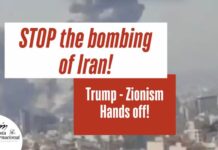
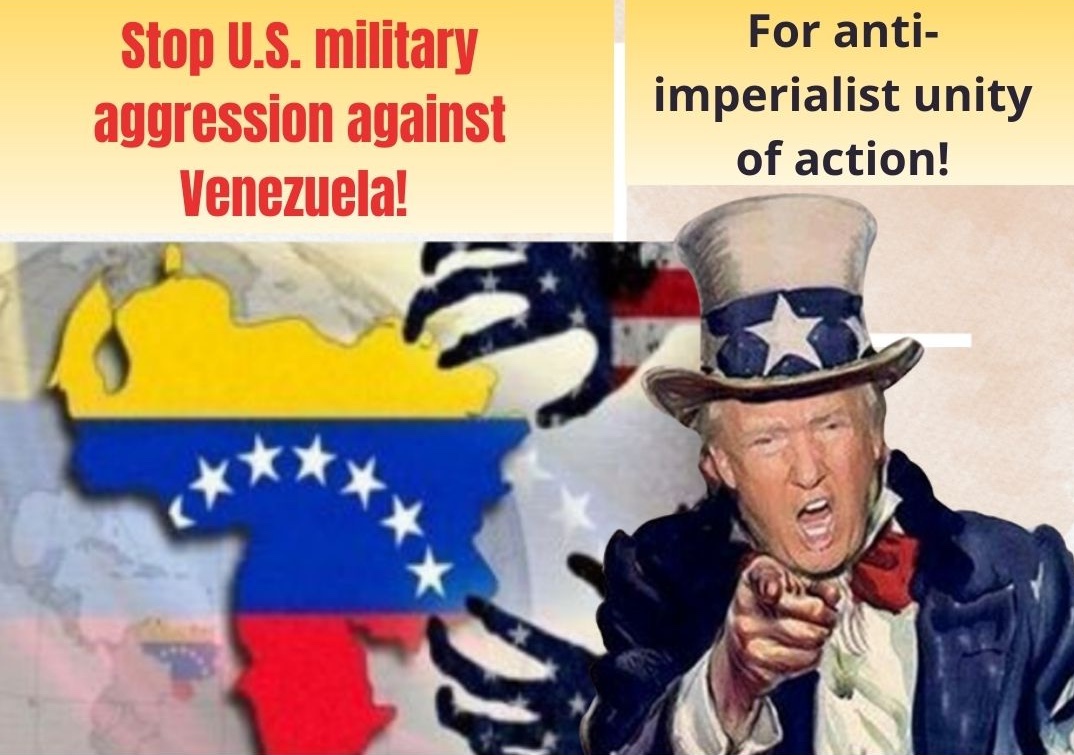
This ongoing aggression brings to the fore the necessity of forging the broadest anti-imperialist unity of action among the peoples of Latin America, in defense of Venezuelan—and regional—national sovereignty. [Denounce flyer the aggression].
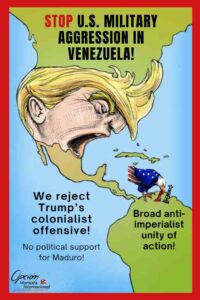
The struggle for national emancipation of Latin American countries against imperialist powers—the primary enemies of workers and oppressed peoples globally—now requires firm rejection of military intervention and the presence of foreign forces in the region, as well as the demand for the immediate withdrawal of the U.S. naval deployment in the Caribbean.
Consequently, the continent’s governments identified as “left”—Gustavo Petro, Ignacio Lula da Silva, Gabriel Boric, and the government of Mexico—regardless of their differences with Nicolás Maduro, and without necessarily supporting him politically, bear a historic responsibility: to convene continental anti-imperialist unity and mobilization in defense of Venezuela and Latin America.
Similarly, working-class organizations must urgently mobilize youth, labor sectors, and the popular masses in resistance to this aggression. Equally essential is an active position of solidarity with the Palestinian people and a categorical rejection of the genocide they are facing.
The fight against U.S. imperialist aggression in Venezuela cannot be separated from internationalist solidarity with Palestinian resistance, despite different contexts.
Just as Zionism—backed by the United States—executes genocide in Palestine to dispossess a people of their land and their right to exist, in Venezuela, imperialism seeks to subjugate a nation to regain political and economic control. Hence, defending Venezuelan sovereignty and rejecting the genocide in Palestine together form the struggle against the imperialist offensive—calling for the broadest unity of action among workers and oppressed peoples globally.
For the broadest unity against the threat of military intervention in Venezuela:
-
One continental cry: No to U.S. military intervention. Yanks out of Latin America and the Caribbean!
-
Yanks out of the region; the Caribbean is not their nation!
-
For the Second Independence of Latin America: total rupture with NATO and Colombia’s submission pacts with the United States.
-
For Venezuela and Palestine, one struggle against imperialism and oppression!
-
Neither Trump nor Netanyahu: Respect Venezuelan sovereignty! Palestine will be free, from the river to the sea!
[1] Infobae. August 31, 2025.
[2] France Joins the United States and Reinforces Military Presence in the Caribbean.
Bryan Ferney Valencia Rios. August 25, 2025.
[3] The “Cauca Mission” was launched by the government of Gustavo Petro in June of last year, naturally without mentioning that it involves the U.S. Department of Defense (DOD) and the Bureau of International Narcotics.
[4] Portafolio. May 15, 2014.
[5] Chinese private company produces oil in Venezuela under a 20-year agreement. La República. August 23, 2025.
[6] “A Military Base on Gorgona Island?” By Darío González Posso, Catalina Toro Pérez. April 20, 2024. https://indepaz.org.co/una-base-militar-en-la-isla-gorgona/
[7] The Minister of Defense, Pedro Sánchez, highlighted the coordinated efforts and international cooperation being carried out in the fight against drug trafficking. In this context, cooperation with other countries such as the United States stands out, aimed at strengthening its presence in the Caribbean Sea to support operations against transnational criminal networks. (El Colombiano, August 14, 2025).
[8] Nicolás Maduro entrenches himself behind the banner of the foreign threat. El País. Alonso Moleiro. Caracas – August 29, 2025.