
Irene Idris – June, 12 2025
Since October 8, 2023, humanity has faced the Great Catastrophe: the annihilation of the Palestinian people at the hands of Israel.
This is unfolding in a global context marked by the plundering wars of world powers (imperialisms), through the military conflict in Ukraine and the offensive led by the far-right Donald Trump against immigrants—an initiative previously launched by Democratic presidents Barack Obama and Joe Biden, and now echoed by ultra-reactionary governments in Latin America and Europe. This offensive includes attacks on democratic freedoms and labor rights, the persecution of immigrants, the Palestinian and LGBTQ+ communities, and has resulted in the dismissal of thousands of public sector workers.
However, amid this bleak global scenario, workers and the masses are showing resistance through massive mobilizations, union and national strikes, uprisings, and other actions that reveal their determination not to be crushed by the offensive launched by world powers and the local governments that serve as their miserable agents.
A BRIEF OVERVIEW OF THE GLOBAL CONTEXT IN WHICH MASS RESISTANCE IS TAKING PLACE
What are the main expressions of the violent offensive by the powerful against the oppressed?
The Great Catastrophe: the Extermination of the Palestinian People in Gaza
The population of Gaza is utterly defenseless, as it has no national army. It remains at the mercy of the Israeli occupation forces, who continue to displace civilians, carry out daily bombings, and assassinate medical personnel to prevent the treatment of the wounded and critically ill. They kill journalists in an attempt to silence coverage of the horrors taking place. Currently, not only does Israel block the entry of food into the Strip to provoke death and humiliation, but it has also introduced a new method of mass killing: using the trickle distribution of food as a weapon, opening fire on people as they try to access rations at distribution centers under Israeli military control. Thus, Zionism has turned food distribution centers into execution sites.
The Slaughter of Children – Ethnic Cleansing in Gaza
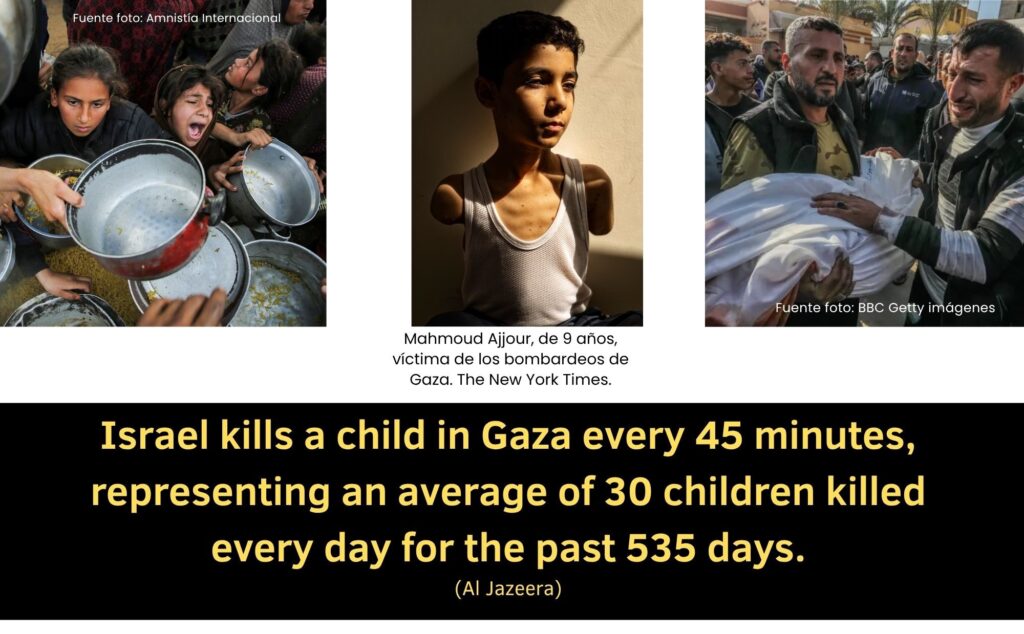
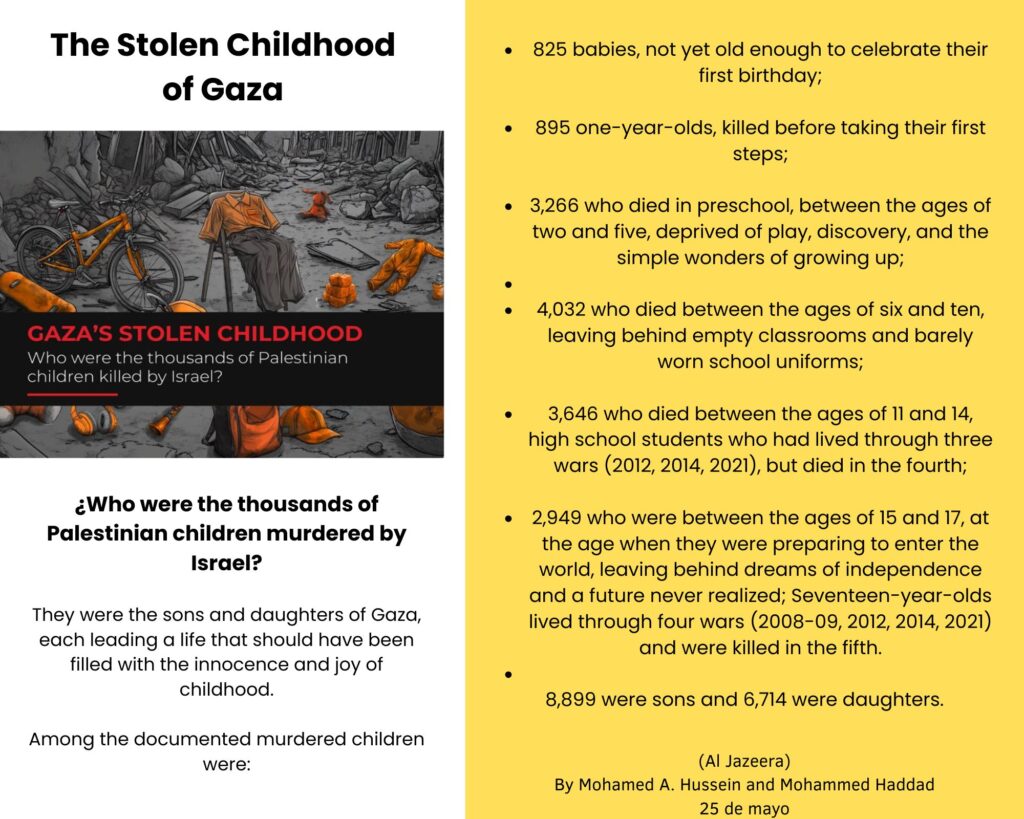
Since October 8, 2023, over 16,500 children have been killed, and many more injured, mutilated, or orphaned. This figure illustrates the scale of the horror in Gaza, the tragedy of the Palestinian community, and, in a broader sense, of humanity as a whole.
In May 2025, Zionist leader Benjamin Netanyahu told the media that Israeli occupation forces would enter Gaza “with full force to complete their mission.” The order: eliminate everyone. “Anyone you find there is an enemy.” “If you identify them, eliminate them,” were the instructions of a battalion commander to his soldiers, as recorded in a video released that same month (The Guardian).
[See also: “Urgent Mobilization Needed to Stop Zionism”][También puede ver: “Urge la movilización y lucha para detener el sionismo”]
The situation in Gaza tragically echoes the atrocities suffered by Jews, Roma, leftists, and democrats during the Holocaust, when Nazi forces carried out a systematic racial extermination. Similarly, today’s Israeli occupation forces are using different methods to eliminate Gaza’s population.
Just as 80 years ago the Nazis implemented the “final solution to the Jewish question,” today the Israeli death cabinet, under Netanyahu’s leadership, has designed a “final solution to the Palestinian question” to complete the ethnic cleansing and mass expulsion process begun before 1948. Since then, Israel has relied on the economic, political, and military backing of the U.S. government and financial oligarchy, as well as the support of European heads of state, global elites, and the complicit silence of China, Russia, and most Middle Eastern governments and bourgeoisies.
Furthermore, the horror in Gaza—reminiscent of Nazi atrocities—reveals that Israel is not an anomaly but an integral and strategic part of the imperialist capitalist system that dominates the world. It was through a UN resolution that colonial occupation and the declaration of an artificial state were legitimized to violently seize and settle the territory of historical Palestine. Israel was created as a key outpost for imperialist control in the Middle East.
Israel’s cruelty reflects the moral decay of a system ruled by a handful of ultra-wealthy elites—a system that, as Marx aptly observed, “emerged dripping from head to toe, from every pore, with blood and dirt,” and still does. A system that expanded and solidified through the annihilation, subjugation, and extermination of native populations for the plundering of their lands and resources, and that continues to exploit and dominate most countries and peoples today.
It is within this framework that Trump’s sinister enthusiasm for Gaza’s devastation becomes understandable. In a press conference, he stated: “We have the opportunity to do something that could be phenomenal. And I don’t want to be a wise guy… but the ‘Middle East Riviera’—this could be something truly magnificent.«.[1]
War in Europe: Inter-Imperialist Plunder and the Rise of Militarism
In addition to the Second Great Catastrophe unfolding in Gaza, the international situation is defined by the plundering war being waged in Ukraine, now entering its third year. In this conflict, imperialist powers—the United States and Europe—are competing with Russia not only for control of Ukraine and the region, but also for a redivision of global influence, often referred to by analysts as the “new world order.”
Despite internal contradictions, the United States and Europe share a common goal in this war, driven by their respective economic and geopolitical interests, all of them backed by NATO.
This military conflict has brought only devastation to the populations of Ukraine and Russia, who have been dragged into the carnage of war under the guise of false “nationalist” narratives that ultimately serve the interests of the world’s economic powers. While Zelensky, the United States, and European governments portray it as a struggle for national liberation, Russia frames it as a war to “defend the homeland” and ensure “national security.”
Death and Devastation
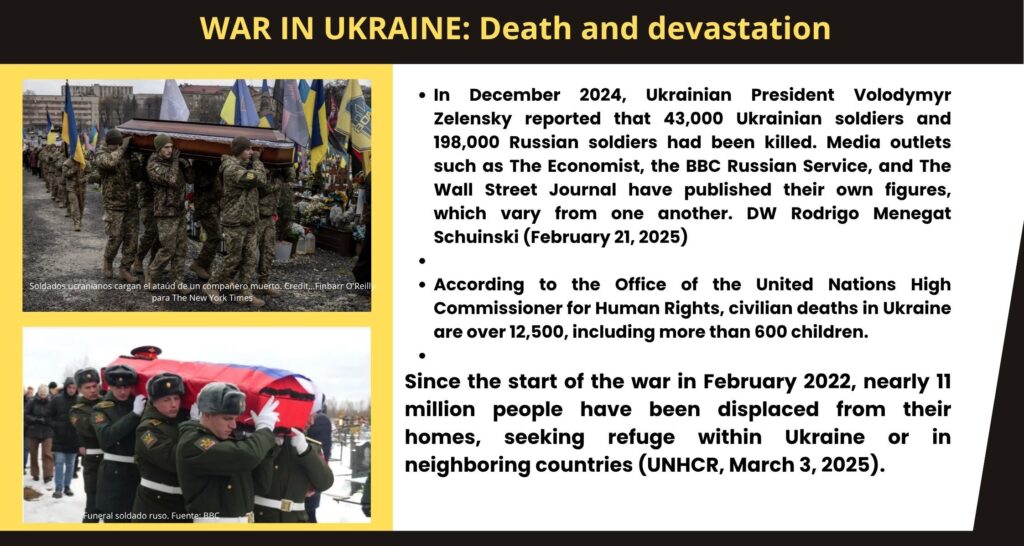
According to a recent study, “military casualties in the war in Ukraine are nearing 1.4 million.” In addition, “nearly 11 million people have been forced to leave their homes, seeking refuge either within Ukraine or in neighboring countries” (UNHCR, March 3, 2025), leaving the country in ruins.[2]
This war serves only the economic and political interests of the warring powers, not those of the working class or the most vulnerable sectors. Instead of addressing their needs or improving their living conditions, it exacerbates their suffering. Therefore, in the face of a clash between two reactionary camps, workers should not align themselves with either side, as both bring only death and destruction.
Competition and conflict among imperialist powers for control of regions and markets—although not reaching the dramatic proportions seen in Ukraine—are also evident in Latin America, Africa, and Asia.
The Storm Clouds of Militarism
The storm clouds of militarism among the imperialist powers continue to threaten global stability, as nuclear-armed nations prepare for war—posing a constant danger to humanity.
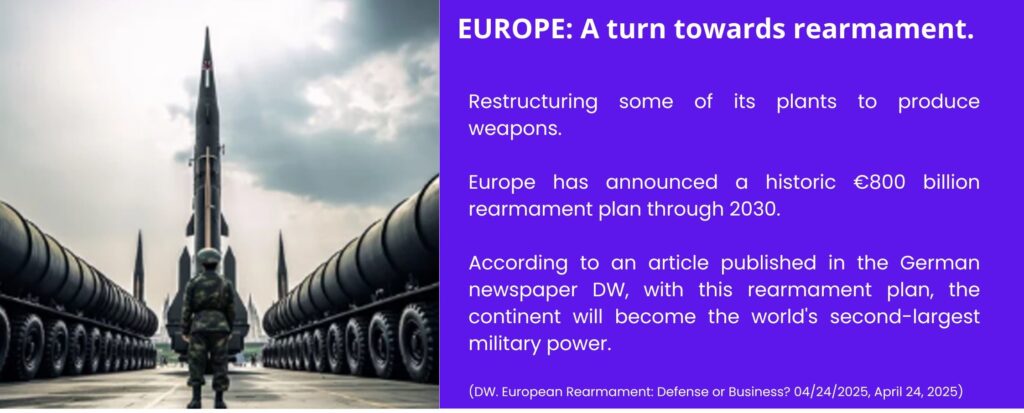
All imperialist states are expanding and modernizing their military and nuclear arsenals. As a result, global spending on nuclear weapons reached a staggering $91.5 billion in 2024, setting a new record. This surge has been driven in part by the war in Ukraine and escalating rivalries among imperialist powers.[3]
A clear example of Europe’s turn toward rearmament and preparation for war is the United Kingdom’s defense plan, titled the Strategic Defence Review. Prime Minister Keir Starmer introduced the plan in early June, warning in a press conference that:
“The British armed forces are preparing for a possible war. We live in a world more dangerous and unpredictable than at any time since the Cold War,” and “To deter conflict, the best approach is to prepare for conflict.” [4]
The plan’s co-author, General Sir Richard Barrons, also stated:
“This is the most profound transformation of the British Armed Forces in 150 years.”
This means the UK is set to make its largest military expenditure since the Cold War. (France 24) [5]
The Trump Offensive and the Global Far Right
Working people, the poor, and oppressed communities—not only in the United States but around the world—are facing an international offensive led by the far right, with Donald Trump at the helm. His crusade is backed by like-minded figures across Latin America, including Milei, Bukele, Novoa, and Boluarte, among others, as well as reactionary currents from both bourgeois and middle-class sectors that serve as his social and electoral base.
Moreover, the narrative of an all-powerful, unstoppable Trump—similar to that of Israel—is amplified by major media outlets, bourgeois governments, and their allies. This portrayal is strategically used to demoralize workers and resistance movements, suggesting that submission is the only viable path. However, this perspective is one-sided. By focusing solely on the power of reaction, it omits a crucial dimension of reality: the resistance of the masses.
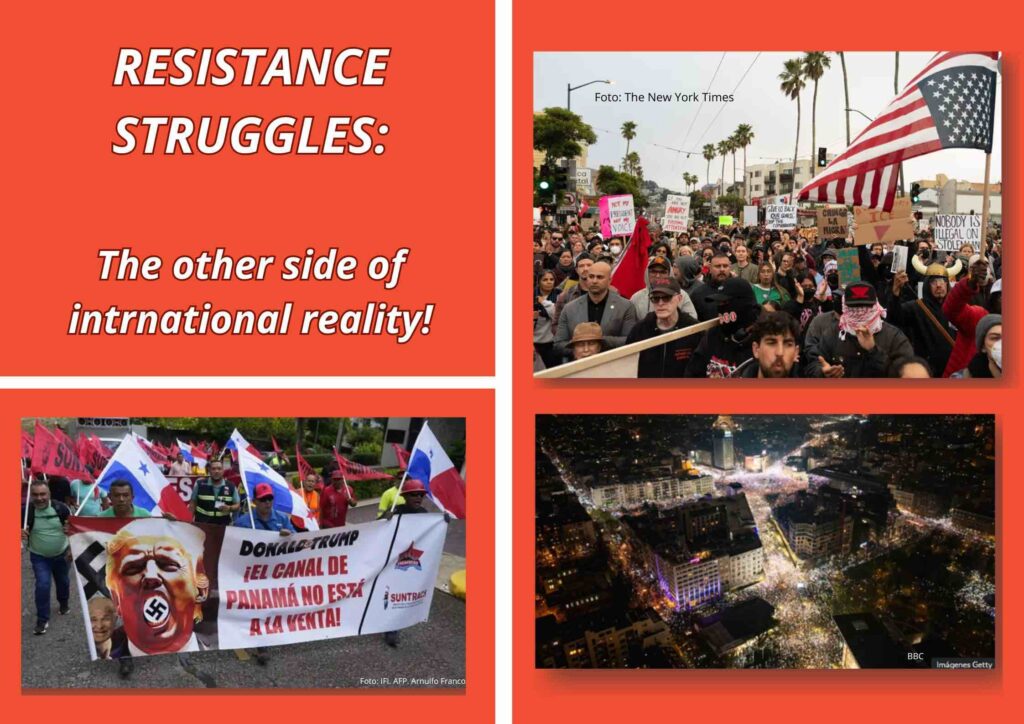
MASS RESISTANCE: THE OTHER SIDE OF INTERNATIONAL REALITY
Amid this bleak scenario, the rise of resistance struggles represents the other pole of the global reality—one that must be acknowledged. These struggles reveal the determination of the masses to say ENOUGH to abuse, injustice, and the burden of elite-driven crises.
Across the United States, Europe, Panama, and other Latin American countries marked by deep inequality, we are witnessing numerous actions: protests, social uprisings, strikes, and growing discontent—all of which constitute key manifestations of today’s mass resistance. These actions are increasingly frequent, indicating a dynamic trend toward expansion and consolidation.
Although still largely defensive, fragmented, and weak on the international level, this economic and political resistance has begun to carve out a path of confrontation against capitalist governments and their offensive—a scenario that, for many, once seemed unlikely.
Given the magnitude of Trump’s aggressive attacks and those of his allies in the ruling powers, these resistance struggles across different countries and regions of the world could shift the balance of power in favor of the working class and the oppressed. They hold the potential to launch a counteroffensive and revive an international surge of struggle, similar to that which existed prior to 1990.
Nonetheless, this objective trend faces a significant obstacle: the absence of national and international leaderships truly committed to defending workers’ interests and confronting government-led attacks and genocide in Gaza through direct action.
The central issue is that, almost without exception, most current leaderships channel popular discontent and struggle exclusively into electoral and parliamentary activity. Their goal is to neutralize the threat these struggles pose to dominant elites.
Why Define It as a Struggle of Resistance?
It is appropriate to define these developments as a global struggle of resistance. However, since “resistance” has become a catch-all term, we align with the definition provided by revolutionary Marxist Nahuel Moreno, who characterized resistance as disjointed struggles in the face of an advancing enemy:
“For us, resistance is a kind of political, social, and economic guerrilla warfare—not military—serving as the only form of defense… against a much more powerful and triumphant adversary.”
“That is why blows are struck here and there, at specific times and places, only to retreat again. Resistance is political, union-based, social, cultural—but taken as a whole, it fights battles in some areas and then shifts to others. It consists of a multitude of desperate, defensive actions in response to the advance of a victorious power… carried out by defenseless masses, it is defensive and fragmented. But once the mass movement gains a unifying axis, the counteroffensive will begin.”
These characteristics define both the nature and scope of current actions, though they do not imply that the dynamic cannot shift. In fact, the situation could evolve positively if the mass movement succeeds in building a unifying leadership.
SOME EXPRESSIONS OF INTERNATIONAL RESISTANCE
Panama, the Backyard of the U.S.: “The Largest Protests in 30 Years”
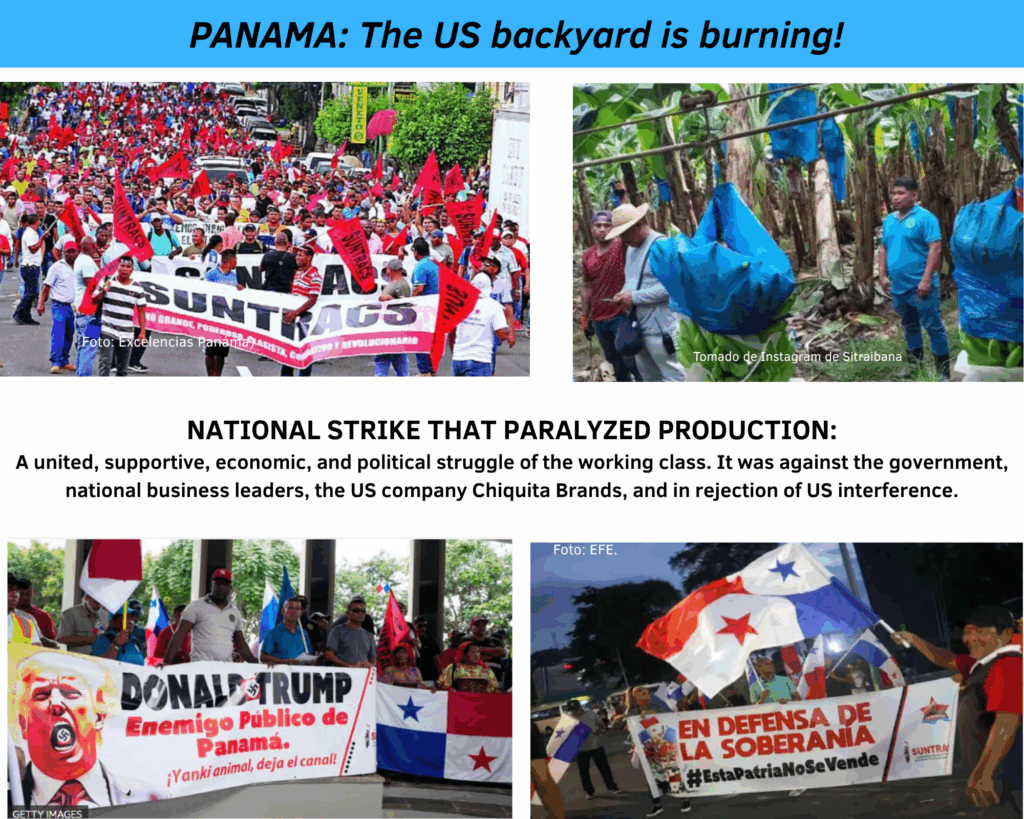
Since late April of this year, Panamanian workers launched a national strike, beginning with a teachers’ strike and joined by the powerful construction workers’ union SUNTRACS[5] and the Banana and Agricultural Workers’ Union (SITRAIBANA), which brought banana plantations owned by U.S. multinational Chiquita Brands to a halt. Indigenous communities and students also joined the strike.
This forceful national strike has paralyzed key sectors of the economy in protest against the pro-U.S. government of José Raúl Mulino and U.S. military and political interference in Panama.
“These are the largest protests in 30 years,” said political analyst José Eugenio Stoute to DW. “The government has lost control of two provinces—Bocas del Toro, now under the strikers’ control, and Darién, controlled by indigenous communities. In the capital, there are marches every 24 hours.”
The main triggers for the protests were:
1. A social security reform in March that slashed labor and retirement benefits for hundreds of thousands of workers;
2. President Mulino’s proposal to reopen a copper mine, violating a 2023 Supreme Court ruling mandating its closure after mass protests;
3. The signing of a memorandum allowing the U.S. to return to its former military bases near the Panama Canal and increase its military presence on Panamanian soil.[6]
As of today, the struggle continues. The government and business sector have responded with harsh repression. On May 23, authorities arrested two leaders of SUNTRACS, the country’s main construction union. On June 6, Chiquita Brands fired 7,000 workers, citing a government ruling declaring the strike illegal. Nevertheless, workers remain mobilized in the streets.
This strike is significant because:
- It unites the working class, indigenous communities, and segments of the middle and popular classes in solidarity;
- The working class is a central protagonist;
- It is a unified struggle that goes beyond economic demands and has become a political confrontation against imperialism, rejecting the U.S. military presence, colonial aspirations over the Panama Canal, and interference in national sovereignty;
- It opposes a U.S. multinational corporation—Chiquita Brands;
- It is taking place in a geographically strategic country for global trade, especially amid commercial tensions between the U.S. and China.
This powerful national strike is of critical importance because it challenges not only the local government and employers, but also U.S. corporations and imperial interests. By confronting a U.S. multinational and opposing U.S. intervention and colonial ambitions over the Canal, this unified national struggle has taken on an anti-imperialist character—and it is led by the working class.
[See also: “Trump’s Colonial Offensive”] [También le puede interesar: “La ofensiva colonizadora de Trump”]
United States:
Protests in Los Angeles – A High Point in the Immigrant Struggle Against Trump
The demonstration held on Friday, June 6, in Los Angeles against the raids conducted by U.S. Immigration and Customs Enforcement (ICE) rapidly escalated into intense clashes with the Los Angeles Police Department, which intervened to suppress the protest. The situation intensified further with the deployment of troops ordered by President Trump, who sent 4,000 members of the National Guard and 700 Marines.
This authoritarian decision—made without the consent of the Governor of California or the Mayor of Los Angeles, and in violation of legal norms even within the bourgeois framework—exposed deep divisions within the U.S. ruling class. One symbolic rupture was the public fallout between Elon Musk and Trump.
Far from retreating in the face of this massive military deployment, the immigrant struggle in Los Angeles sparked widespread indignation and solidarity among the American population, spreading to a national scale. It marked a significant turning point in the resistance against the Trump administration’s policies. Thousands took to the streets in other U.S. cities to show support for immigrant workers and to express outrage over the government’s repressive response.
Today, a wave of discontent against the Trump administration is sweeping across the country. In response, a major national day of protest was called for Saturday, June 14, under the banner “No Kings,” to reject authoritarianism, militarization, and the entirety of Trump’s policies.
Likewise, the current direct struggles against Trump are a continuation of the massive national mobilization carried out by broad sectors of the population on April 5, when a historic march took place under the slogan Trump “Hands Off”—hands off immigrants, human rights, the Palestinian community, students, and the working class. These struggles are also part of the large-scale protests in solidarity with the Palestinian cause led by university students and wide segments of the public. They include as well the important and historic labor strikes that occurred previously—most notably those of the United Auto Workers, entertainment industry employees in Hollywood, and the healthcare sector.
Through these actions, working-class immigrants and other segments of the U.S. population are demonstrating that Trump does not have absolute control and are beginning to dismantle the myth of his supposed “indestructibility.”
Actions in Solidarity with the Palestinian Cause
Since October 2023, mass solidarity actions with the Palestinian people have been taking place across the United States and Europe. Despite ups and downs, they have persisted. Across the world, thousands are standing up and raising their fists in support of the Palestinian cause, demanding: Stop the genocide! End the ethnic cleansing! No more Zionist colonization and occupation! Palestine will be free from the river to the sea!
In the United States, April of last year saw major protests against the genocide, with large demonstrations in major cities and on the campuses of prestigious universities such as Harvard, Columbia, the University of South Carolina, University of Texas, University of Minnesota, and the University of Pennsylvania, among others.
In Europe, large solidarity actions have also taken place. One notable example was the boycott carried out by dockworkers at the port of Marseille in southern France, who refused to load military supplies bound for Israel. In a statement, the CGT union declared that they would not participate in the supply of weapons “that perpetuate civilian suffering.”.[7] Another major action was the march in The Hague on May 18, 2025, in which over 100,000 people took part under the slogan “Draw a red line for Gaza.”
Additionally, in some Middle Eastern and North African countries, important demonstrations have taken place—such as the one held on April 6, 2025, in Rabat, the capital of Morocco—one of the largest seen in the country in recent months.
Europe: Strikes and Marches
In Europe, one of the most significant ongoing struggles is taking place in Serbia, where public discontent has reached a historic level and has already achieved a major victory: the resignation of the Prime Minister.
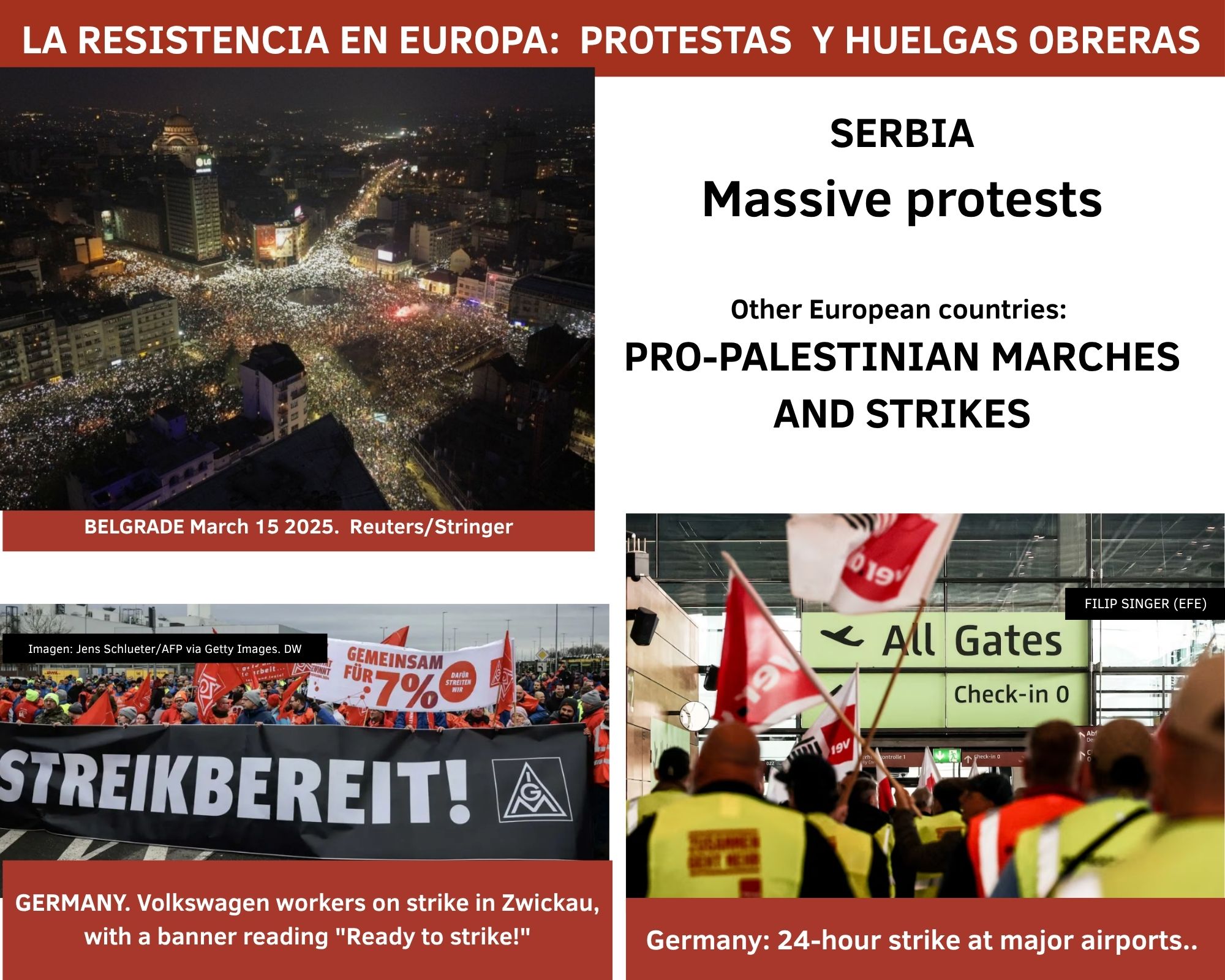
What began as a student-led movement has expanded to include various social sectors, including the working class. Five major trade unions have united in a massive protest that brought together over 300,000 people. “In my 20 years of union work, I’ve never seen these five unions in the same protest—not even in the same room working on something together,” one union leader remarked.[8]
The catalyst for the movement was the collapse of a canopy at the Novi Sad railway station in northern Serbia on November 1 of the previous year. The incident killed 15 people and sparked an unprecedented social movement demanding transparency, justice, and accountability from the authoritarian and pro-Russian president Aleksandar Vučić.[9]
Alongside these mass protests against Israel’s genocide of Palestinians, the European working class has also launched several waves of labor strikes—ranging from factory stoppages to general strikes—throughout 2024 and 2025. Germany has been a central hub of these actions, where workers are demanding wage increases and improved working and living conditions.[For more information, see: “May 1st, International Workers’ Day: A Day to Remember the Power of Labor Struggle.”]
Resistance in Latin America
Since the far-right president Javier Milei took office in Argentina, massive protests have erupted across the country involving a wide range of social sectors—workers, students, teachers, feminist collectives, the LGBTQ+ community, retirees, and healthcare professionals. These mobilizations are in response to mass layoffs and severe austerity measures implemented by the government, which have deeply affected public health, scientific research, and teacher salaries.
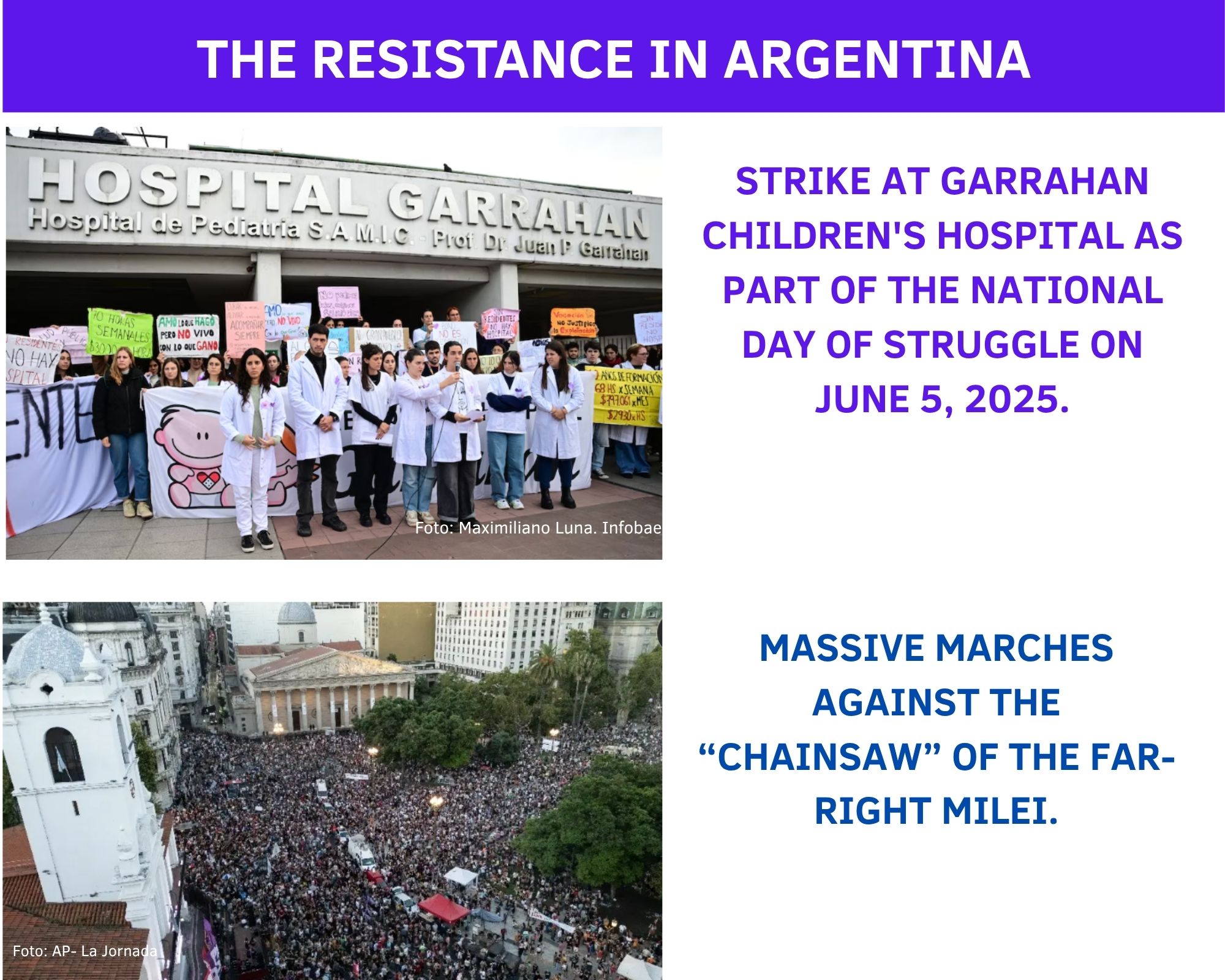
In a country where more than half the population lives in poverty—according to Argentina’s National Institute of Statistics and Censuses (INDEC)—and where the cost of living is among the highest in Latin America, the situation for retirees is particularly alarming. “The minimum pension has been reduced to $300, while the basic family basket exceeds $1,200,” leading to near-daily marches in support of retirees.
A particularly significant event occurred on June 5, 2025, when the State Workers’ Association (ATE) called for a national day of action in the health sector. Doctors from the renowned Garrahan Children’s Hospital in Buenos Aires joined a 24-hour strike to demand better wages.
Taken as a whole, these resistance struggles—if they continue to grow and reach new sectors, as recent developments in the United States and Panama suggest—represent a powerful momentum for the working class and oppressed peoples. They could give rise to new, large-scale confrontations that are combative and politically consequential.
As mentioned earlier, the major obstacle lies in the fact that most existing leaderships have abandoned the goal of eradicating this exploitative, violent, and miserable system. Years ago, they shifted toward liberal-democratic and deeply reformist practices. On the international front, they have buried their heads in the sand of outdated nationalism, abandoning the fight for liberation from U.S. imperialism and other global powers, and failing to stand in solidarity with the struggles of oppressed peoples worldwide.
The Path of Raised Fists
This wave of resistance reveals that global reality extends far beyond the dark landscape of ethnic cleansing in Gaza, the war in Ukraine, and the reactionary attacks by Trump and other allied governments of the imperialist powers. These ruling elites continue to use workers and the most vulnerable as pawns in their geopolitical disputes and wars to protect their multinational corporations and economic interests.
It is through these resistance processes that the objective conditions may arise for the working class to build new leaderships capable of reclaiming trade unions and restoring their original purpose: to defend workers’ rights and act as tools of struggle for better living and working conditions. Likewise, it will be essential to build political organizations rooted in the working class, rather than remaining trapped in the cycle of supporting employers’ parties and politicians—as is currently the case in most countries.
This is the only path to break the siege and establish a unifying axis for the various struggles, with the goal of launching a counteroffensive and forcing back the financial oligarchy that dominates all nations, continues to destroy the environment, and pushes humanity toward barbarism. This elite is directly responsible for the elimination of Palestinians in Gaza and benefits from attacking labor rights and democratic freedoms through regressive laws imposed across countries, while heaping endless hardship on society’s most vulnerable.
The struggles unfolding in the United States, Europe, Panama, and beyond are, objectively and indirectly, helping the Palestinian cause. They strengthen the fight of all the oppressed and exploited people of the world on their path toward liberation. This is the other side of international reality: the resistance of the masses—resolute in confronting the brutal offensive of the powerful. And the tendency is for this resistance to grow, as evidenced by the nationwide spread of the protests that began in Los Angeles.
Unconditional solidarity with all direct mass actions!
Mass mobilization to stop Israeli Zionism!
¡Trump: Hands off immigrants, the Palestinian community, and labor rights!
Trump: Hands off Latin America!
[1] https://www.dw.com/es/gaza-los-negocios-de-la-familia-trump-en-medio-oriente/a-71575544
[2] (ACNUR 3 de marzo 2025)
[3] The nine nuclear-armed states – Russia, the United States, France, India, China, Israel, the United Kingdom, Pakistan and North Korea – have modernized their nuclear arsenals, and several of them will deploy new systems by 2023. France 24 – 07-06 2024
[4] To deter conflict, it’s best to prepare for conflict.» BBC News, June 2, 2025. Luisa Pulido Griffin. The United Kingdom is betting on a massive rearmament with an eye on Russia. France 24.
[5] “As part of the growing national mobilization, the National Union of Construction and Related Workers (SUNTRACS) announces that it is joining the indefinite strike initiated by teachers this Wednesday, April 23, in rejection of Law 462 and in defense of the rights of the Panamanian people.” Sutracs statement. April 25, 2025
[6] Sandra Weiss – 04/06/20254 de junio de 2025 – DW
[7] https://nuevarevolucion.es/estibadores-del-puerto-de-marsella-se-niegan-a-cargar-material-militar-con-destino-a-israel/
[8] France 24. 01-05-2025. “In Serbia, around 500,000 of the country’s 2.36 million workers are union members, according to union estimates. These five unions, which cover most industrial sectors, account for the majority of this membership.”
[9] Editorial de El País, Escuchar a los jóvenes de Serbia. España. 01 abril de 2025.