Publicado en español el 26 octubre 2025 -08 noviembre 2025
Published in Spanish on October 26, 2025 – November 8, 2025
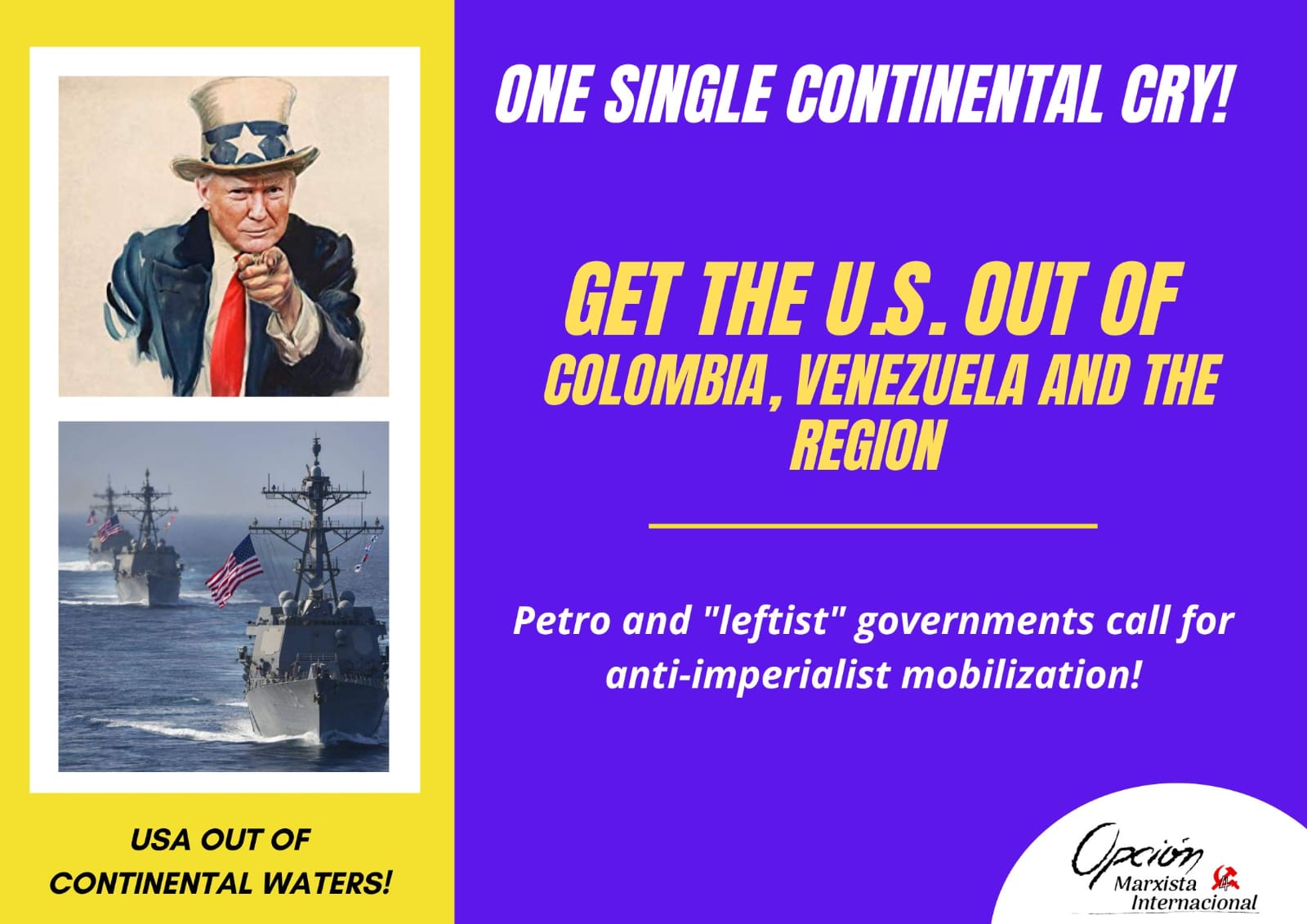
The aggressive attack by the Donald Trump administration against Colombia, Venezuela, and the region, with political accusations and a powerful military deployment in the Caribbean and Pacific Oceans, continues to escalate and expand.
First, the massive naval presence off Venezuela has been compounded by the deployment of the USS Gerald Ford aircraft carrier (October 24, 2024), the largest in the U.S. fleet. Second, the number of military personnel has increased, and the siege of Venezuela has intensified with aerial harassment by two B-52 bombers from Louisiana that flew over the Venezuelan coast. Third, the lethal attacks, including several bombings of vessels in the Caribbean Sea, have spread to the Pacific Ocean, where a ship was also bombed off the Colombian coast.
Finally, the Trump administration has extended its aggression from the military to the political sphere, decertifying Colombia, withdrawing visas, and imposing direct sanctions against President Gustavo Petro by including him, along with Armando Benedetti and others, on the so-called “Clinton List.” Furthermore, it has falsely labeled Petro a “thug” and “drug trafficking leader,” among other verbal attacks, while threatening to impose economic sanctions and potentially military aggression, not only against Venezuela but also against Colombia.
Extrajudicial executions
The extrajudicial killings of crew members of vessels in Caribbean and Pacific waters, under the unsubstantiated accusation of being drug traffickers, demonstrate once again that for the U.S., international law is worthless. At the same time, these events reveal the fascist characteristics of the regime of international domination that the U.S. imposes on the peoples of the world.
The war on Drugs: A cover for colonizing us
The war on drugs, now labeled “narco-terrorism,” is nothing more than a cover used by the United States, and Donald Trump in particular, to subjugate the governments and peoples of Latin America.
As we pointed out in the article “No to US Military Intervention in the Region”: “the true motivation of the United States in Latin America is to guarantee control over strategic resources vital to its economy and maintain its hegemony in the face of the advance of competing powers (Russia and China).” (See also: “No to US Military Intervention in Venezuela”).
To this must be added the objective of securing geopolitical control over the waters of the Caribbean Sea and the Pacific Ocean as areas of influence for its imperialist interests and plunder.
President Petro himself acknowledges the imperialist motivations: “The excuse of the fight against drugs…is actually a program of colonial control.” This is what he said in his speech during the demonstration held in Bolívar Square, though it goes no further than that, without taking any concrete measures to defend the country.
A historical domination and global offensive
The current offensive by the United States government is part of the historical policy of interventions and aggressions by this country’s governments against our continent. And currently, it responds to its policy of regaining control of Latin America, now contested by its global rivals, China and Russia. (See also: “La ofensiva colonizadora de Donald Trump”).
On the other hand, for the US president with monarchical delusions, this aggression serves as a smokescreen to hide the flame of discontent in his country, where thousands are mobilizing in most of the nation’s cities, repudiating his authoritarian abuses under the slogans of “No Kings” and “Hands off” immigrants, labor rights, and democratic and political rights. (See also: “No Kings! Trump and His War on Democratic Freedoms”)
The sovereignty of Colombia, Venezuela, and the region under threat
What is presented as an “anti-narcotics” or “national security” operation for the United States is nothing more than a policy to further subjugate Colombia and regain political and economic control over Venezuela.
These actions constitute a blatant interference in the internal affairs of both countries and a direct threat to the already diminished sovereignty of the entire Latin American region.
The disrepute of the Maduro regime, as well as Petro’s constant missteps, blunders, and vacillations, in no way justify echoing the simplistic argument that this is a personal attack on Petro or Maduro. As Trump himself has stated, “We will take very serious measures against him and his country.” By maintaining this argument, the extreme right and the Venezuelan and Colombian right wing are positioning themselves, as they always have, as miserable agents of Trump’s imperial interests.
For the broadest unity of action of the peoples of Latin America
In the face of this aggression, the broadest and most united mobilization of the peoples of Latin America and the Caribbean is urgently required. It is essential that the government of Gustavo Petro and the other so-called “left-wing” governments in the region call for a great continental anti-imperialist mobilization, demanding the immediate withdrawal of the U.S. military deployment in Caribbean waters, an end to political attacks against Latin American leaders, and full respect for national sovereignty.
It is the responsibility of President Petro, the Historic Pact, and the organizations of the working class — such as the CUT, FECODE, and other trade union federations — to assume their historical duty by summoning their bases and organizing mobilization actions throughout the country, guided by a broad spirit of unity. This call cannot be limited to government supporters, nor can it be instrumentalized or subordinated to electoral or partisan calculations.
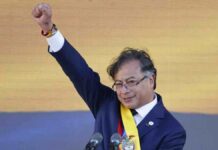
Under the banner of defending sovereignty, President Petro called for a rally in Bogotá’s Plaza de Bolívar (October 24), where he proclaimed: “Trump is not to be answered by kneeling down, but by standing firm and taking to the streets.” However, he did not issue a specific call to mobilize or carry out concrete actions in defense of national sovereignty or in rejection of U.S. interventionism.
Although Petro concluded his speech by declaring that “The time of the people has come, the time of revolutions has come — revolutions of multitudes and peaceful ones,” both he and the Historic Pact (PH) failed to seize that opportunity. Instead of using the moment to call for continental unity and organize an articulated resistance against Trump’s aggression, his government merely clarified that the demonstration’s purpose was to launch the collection of signatures to “call for a constituent election,” that is, to support his electoral campaign.
However, it is still possible to correct course — by urgently and inclusively summoning all political, social, and popular forces in the country and across the continent that oppose Trump’s outrages and that identify as democratic, to mobilize in defense of sovereignty — both national and that of Venezuela and other countries in the region.
This means calling for mobilizations throughout the continent, coordinated and inspired by the “No Kings” protests against Trump, where millions of Americans marched in major cities and small towns across all 50 states. Furthermore, such actions could be combined with and lend regional support to the ongoing protests and mobilizations in Ecuador and Peru against their reactionary governments.
A Principled Anti-Imperialist Position
We, as Opción Marxista Internacional, an organization of workers and internationalist socialists, reaffirm our principled anti-imperialist position, regardless of the clear political differences we have with the governments of Gustavo Petro and Nicolás Maduro. These differences, which we have expressed publicly, in no way, prevent us from leading the mobilization against US aggression. We do so similarly to how we have been demonstrating in solidarity with Palestine and rejecting the genocide perpetrated by Zionism, without this implying support for the policies of its leaders.
Our commitment is not to governments. It is to the workers and oppressed peoples in the anti-imperialist struggle, in defense of national sovereignty, and for the emancipation of Latin America.
Therefore, this position does not imply any kind of political support for governments. But rather the firm conviction that only the united mobilization of the working class, the youth, and the oppressed peoples of the continent can halt the imperialist offensive and pave the way for a second independence and the definitive liberation of Latin America.