Irene Idris – February 4, 2026. Updated
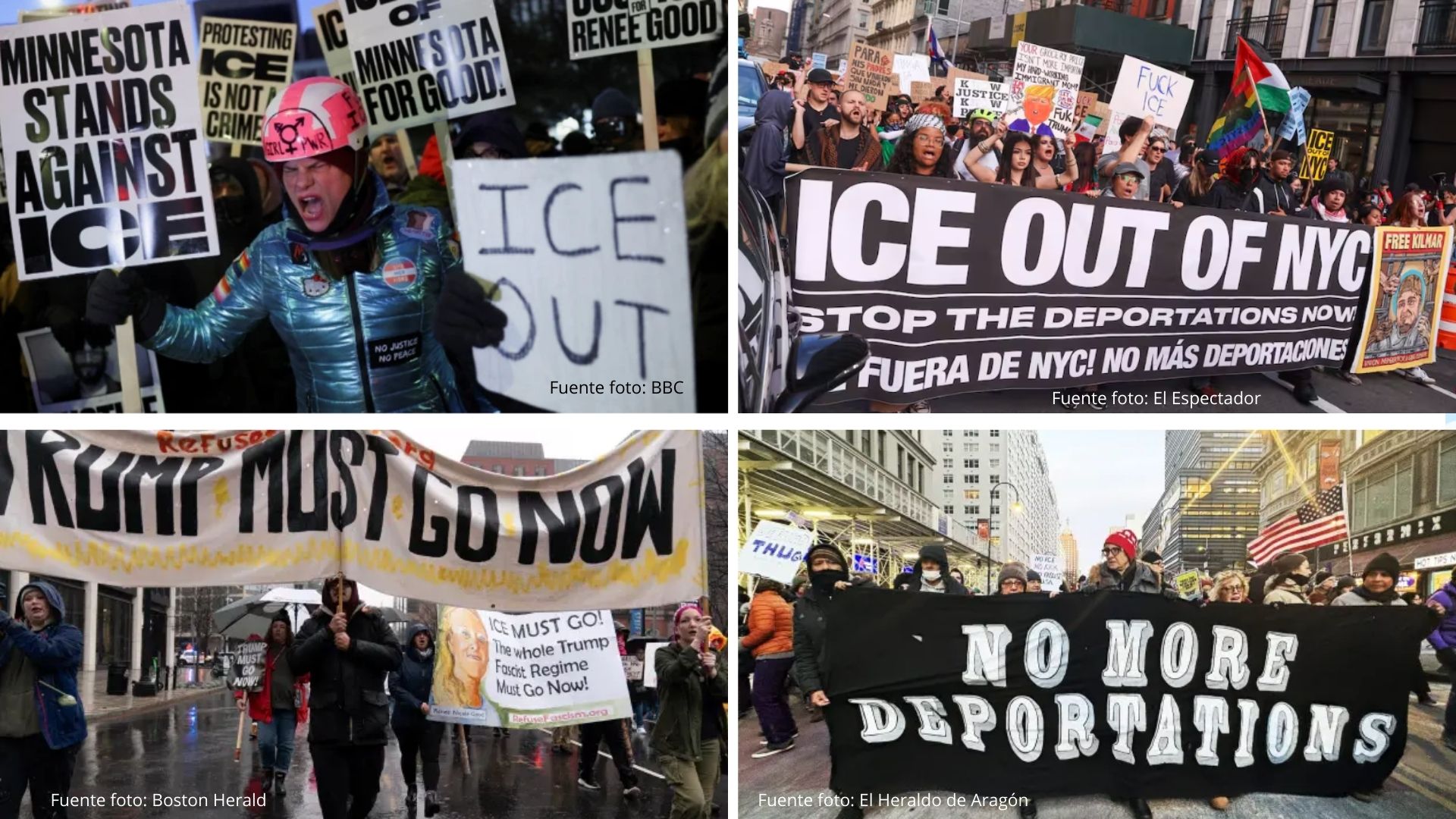
The mobilization against the immigration offensive launched by Donald Trump—marked by repression and killings—not only persists but intensifies and strengthens. Millions of Americans, braving temperatures as low as -20 degrees Celsius and overcoming fear, are taking to the streets en masse to protest immigration raids, following the murders of Americans Renée Good, killed by an Immigration and Customs Enforcement (ICE) agent during a raid, and Alex Pretti, an intensive care nurse, who was shot ten times by two Border Patrol (CBP) agents while other federal agents held him down on the ground. They are also demanding the immediate dissolution of ICE.
The Migrant Nightmare
Numerous accounts describe the human drama and the daily climate of terror experienced by immigrants, many of whom don’t dare leave their homes, stop going to work, school, or medical appointments, for fear of being detained and treated like criminals.
A Minneapolis resident told TVM, “Honestly, my neighbors are terrified. People are being dragged from their homes in their underwear. They think they can do whatever they want to our neighbors…” [1]
Meanwhile, a resident of a neighborhood near the airport explained how the day had started on her streets: “We’ve had ICE raids since very early this morning. The neighborhood pizzeria, the nearest gas station, the park where I play softball… All the abductions first thing in the morning with neighbors jumping out of bed and running around in this heat to try to help. And then you get alerts that they’re gone and there’s just an empty car left. It’s constant”.[2]
Similarly, doctors in Minnesota denounced the fear their patients are experiencing at a press conference at the state Capitol in St. Paul. One after another, they recounted the suffering of patients amid the government’s offensive.
Dr. Roli Dwivedi, former president of the Minnesota Academy of Family Physicians.
A kidney cancer patient disappeared without his medication at an immigration detention facility. It took legal intervention to get his medicine sent to him, though doctors aren’t sure if he’s been able to take it… “I’ve been a practicing physician for over 19 years here in Minnesota, and I’ve never seen this level of chaos and fear,” not even at the height of the COVID-19 crisis, Dwivedi noted.
A diabetic afraid to pick up insulin; a patient with a treatable wound that became infected and required intensive care; hospital staff—from Latin America, Sonalia, Myanmar, and elsewhere—too afraid to come to work.
Our patients are disappearing,” and there are pregnant women not receiving key prenatal care, said Dr. Erin Stevens, legislative chair of the Minnesota chapter of the American College of Obstetricians and Gynecologists, noted that requests for home births have also increased significantly, “even among patients who had never considered this possibility, or for whom it is not a safe option»
Strong Community Organization Against ICE
The mobilization isn’t limited to marches and mass protests. In Minneapolis-Saint Paul, residents have built a community network of support and clandestine communication.
This support includes organizing neighborhood patrols to warn of the presence of federal agents; setting up guards at schools and kindergartens, where volunteers use whistles to warn of raids; raising funds for food, hygiene products, and rent for families unable to go to work; as well as childcare and companionship for the elderly.
Journalist Iker Seisdedos describes this network of solidarity in his article “The ‘Siege’ of Minneapolis: How the Residents of the Democratic City Resist Trump’s Immigration Siege”[3]
In this encrypted social network, each person’s role is defined by a code of emoticons: cars, plates, bandaged hearts… Some patrol the streets looking for masked federal agents, who drive unmarked cars and are armed to the teeth. There are those who administer first aid when things go wrong, those who photograph license plates, and those who check them against available databases.[4]
There are several calls a day for information sharing. When someone reports an ongoing raid, the vehicles of the “observers” in the area speed off to try to prevent it or, at least, to witness or hinder the hunt for the immigrant. Once there, they blow their whistles, record the officers with their cell phones, and confront them. Sometimes they end up arrested
Protests against ICE are multiplying across the country, increasingly involving broader sectors of the working class and society.
From New York to Los Angeles, and from Cleveland, Arizona, to Philadelphia, San Francisco, Denver, Connecticut, and Washington, D.C., large segments of the population are demonstrating en masse in solidarity with Minneapolis and, in particular, with immigrant communities.
Under the slogans “ICE Out!”, “Abolish ICE!”, “Full Rights for All Immigrants!”, and “Stand Up for Immigrant Families!” and “Justice for Alex,” protesters are uniting nationwide.
These protests demonstrate a deep solidarity with persecuted communities and a clear opposition to authoritarianism. As several participants expressed in local media, they marched “to support the good people of Minneapolis and stand up to authoritarianism.”
Teachers and students: “We don’t want ICE in the schools!”
As part of this process, teachers in Minneapolis, Los Angeles, and the Roaring Fork Valley in Colorado, among other cities, have joined the protests against the repressive apparatus of ICE, which persecutes, imprisons, murders, and deports, as well as in solidarity with their immigrant students and their families.
In Los Angeles, educators took to the streets chanting: “We don’t want ICE in the schools!” Educators in the Roaring Fork Valley did the same.
As one educator stated, “The best educators work to protect the most vulnerable people, and some of our students are “Vulnerable,” DeFord said. “That’s why we’re here»
Together with their teachers, they demand: “No more ICE in schools,” “No more arrests,” “No more deportations,” “Abolish ICE.”
From Minneapolis, John Reuss’s English teacher, in an interview with Democracy Now, described the climate of persecution in the neighborhoods while calling on his fellow educators across the country to participate in the planned walkouts:
His account illustrates the climate of fear, resistance, and solidarity:
“Last week, a student logged into class and, halfway through—I teach English—sent me a message saying, ‘ICE is outside my house right now. What do I do?’ I immediately stopped the class, and everyone found out what had happened. Thank God, his neighbors were outside and chased ICE out of their neighborhood. Those agents had been hanging around all morning. This really speaks to our communities, how we organize, and how we stand up for each other, including my students. The fear is so palpable. We need to shut everything down. I’m calling on all educators in this state and this country to shut everything down, including Minneapolis and Saint Paul. We need to shut everything down because if we don’t do it right now, your city will be next.”
Professor Jessica Garraway recounted:
“…I am a teacher, and teachers are organizing, parents are organizing… It is a massive resistance to protect children in our communities. I teach immigrant students, and virtually all of my students are learning virtually right now; parents are afraid to send their children.”.[5]
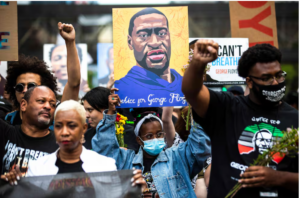
Likewise, protests by high school and university students are spreading across the country. From New York to Texas, young people left their classrooms to voice their outrage against Trump’s immigration policies, demanding the right to study without fear, to live without persecution, and not to be treated as criminals simply for being immigrants.
Alongside their teachers, they demand: “No more ICE in schools,” “No more detentions,” “No more deportations,” “Abolish ICE.”
The wave of protests against the criminalization of immigration and against the Trump administration has reached a magnitude not seen, perhaps, since the historic mobilizations against the Vietnam War.[6]
Support from public figures
The voices of protest are joined by renowned athletes, actors, and musicians such as Mark Ruffalo, Pedro Pascal, Susan Sarandon, Jane Fonda, Jamie Lee Curtis, Whoopi Goldberg, Stephen Colbert, Sharon Stone, Madonna, and Lady Gaga, among others. Bruce Springsteen released the song “The Streets of Minneapolis” and held a concert dedicated to immigrant residents and to the memory of Alex Pretti and Renée Good.
Background and continuity
The current wave of protests is not an isolated or fleeting event. Instead, it represents yet another expression of the social discontent that has been brewing for some time in rejection of state violence and President Trump’s policies. These demonstrations are connected to the massive marches of «No Kings,» «Trump: Hands Off,» and the broad mobilizations of solidarity with Gaza and the Palestinian people, which even garnered the active support of students from the country’s elite universities.
Likewise, it is part of the tradition of struggle in Minneapolis, where the social uprising in response to the murder of George Floyd in 2020 became a symbol of resistance against state racial violence toward the Black population, spearheaded by the Black Lives Matter movement, which marked a turning point in recent U.S. history.
Trump wavers under public pressure
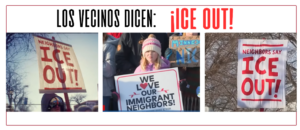
Faced with the pressure of nationwide protests, Trump was forced to relieve Gregory Bovino, the Border Patrol commander in charge of operations in Minneapolis, in an attempt to contain and defuse the national outrage.
He also toned down his rhetoric. According to The New York Times, “Shortly after making the announcement about Homan, Trump and his press secretary, Karoline Leavitt, softened their tone on Pretti’s death and distanced themselves from the inflammatory comments of Miller, Bovino, and Noem. Trump also said he had spoken with Minnesota Governor Tim Walz, against whom he had lashed out just days before.” [7]
Trump: Symptoms of a declining administration
Many media outlets and propagandists systematically promote the idea that Trump is advancing like a “buffalo,” portraying him as an unstoppable force. Some attribute this characteristic to his personality, claiming that his policies and aggressions are not only outlandish but possess unprecedented force. However, this assessment is influenced by what is evident at first glance.
Nevertheless, behind the aggression lies a state of weakness resulting from the growing social discontent among millions of workers and young people who have suffered the consequences of the economic crisis and the authoritarianism of their government, and who are rebelling and beginning to organize, as is happening in Minneapolis, to stand up to their thugs because they no longer accept the impositions of the White House or its reign of terror.
History teaches us that power does not reside in the figure of the leader, but in the social relations that sustain him. As Trotsky pointed out in Bonapartism and Fascism:
The naive believe that royal status is based on the person of the king, on his ermine robes and his crown, on his flesh and blood. In reality, royal status is a relationship between people. The king is only such because the interests and prejudices of millions of people are reflected in him. When those relationships are superseded by the current of evolution, the king becomes an ordinary person. [10]
“King” Trump only came to power because he managed to reflect and capitalize on the interests and prejudices of millions of Americans. But, as is happening today, as mass resistance grows stronger, his apparent invulnerability and power begin to crumble.
The strength and power of a government, a political regime, or a socio-economic system are not measured by the aggressiveness of its actions, but by the real support it receives from the working and middle classes. Ultimately, this support is based on the social relations that legitimize and sustain it. When that support is lost, they collapse like a house of cards.
This is what the history of class struggle and social revolutions reveals: that kings, elites, or entire systems do not crumble on their own, but rather their fall occurs when the social conditions that sustained them change. This happens when the working class and the popular masses withdraw their support.
The MAGA slogan itself reveals the urgency of an elite trying to overcome profound economic difficulties and yearning to «make great again» a country whose power has historically been based on exploitation, war, and plunder.
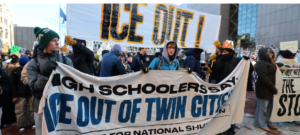
On the international stage, Trump is desperately grasping at straws to restore the hegemony the United States held in the global imperialist system since the end of World War I; to secure the largest share in the fierce division of territories, technological advancements, resources, and markets that is currently being contested globally among imperialist powers.
The “world leader” country is, in reality, standing on the shaky foundations of a system that, after a brief pause following its triumph in the late 1980s, has once again revealed—at least since the 2008 financial crisis—its character as a system in clear decline and decay. All of this is happening within the context of a global economy beset by increasingly acute disputes between the powers, wars, and recurring crises. In particular, the so-called “American Dream” has become a nightmare for immigrants and large sectors of the working and middle classes.
For this reason, Trump violently attacks migrants to terrorize the population; It subjects Venezuela to its total control and systematically threatens oppressed countries.
This is a government that lacks broad support among the working and middle classes. A significant portion of them oppose both its domestic policies—which violate historically hard-won democratic freedoms—and its anti-immigrant and aggressive foreign policies. Therefore, the current wave of protests is of fundamental importance.
According to the article “Trump Wants to Be the World’s Policeman, But the Vast Majority Opposes It,” it is revealed that, “In the case of Venezuela, for example, recent polls from late 2015 and early 2020 show that between 63% and 70% of the American public opposed military action.”
Regarding the possible annexation of Greenland, recent polls indicate that “73% do not support Trump’s idea, and only 19% support it.”[11]
Likewise, regarding a potential military attack against Iran, recent polls indicate that “around 45% of those surveyed oppose US attacks against the Islamic Republic, while 30% are undecided. Only a minority, 25%, are in favor of military action”[12].
Hence the enormous importance of the wave of protests and outrage sweeping the United States, which clearly demonstrates the fragility of Trump and his despotic regime in the face of an increasingly broad sector of society that has taken to the streets in rejection of his government.
The Economic Underpinnings of Social Discontent
The social weariness driving this internal confrontation against Trump is rooted in the economic and social situation that is hitting both the immigrant population and the working class in general.
“Only four out of ten Americans support his administration. Six out of ten Americans believe the cost of living has worsened under Trump, according to the latest AP-NORC Center poll. Barely two out of ten believe his policies have helped, while the rest perceive no change.”[13]
This trend is even more pronounced among young people: “…only three out of ten young people approve of his actions.”
Today, many sectors that, frustrated by Biden’s Democratic Party administration, turned their backs on the continuity candidate and mistakenly believed they had found a way out by voting for Trump—representing the far-right wing of the other major business party in the United States—are now disillusioned and have been compelled to confront him through struggle and street protests.
The Importance of Confronting Trump in the United States
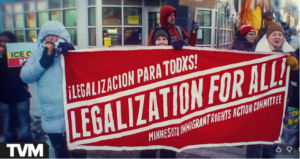
This process of solidarity mobilization by millions of Americans is of fundamental importance to the struggle of oppressed peoples and the working class internationally, and it transcends national borders for several reasons:
- First, it involves the mobilization of one of the largest and most powerful contingents of the global working class, the working class of the United States, along with sectors of the middle class, united around a clear political and class axis: the defense of immigrant workers and their families, and resistance against the attack on the broad democratic freedoms won by the people of that country.
- Second, because only a mobilized working class, together with its allies, can deliver a defeat to US imperialism from within. Furthermore, this struggle is not unfolding in isolation, but rather is combined with other international mobilizations of significant sectors of the European working class, heirs to a long tradition of organization and struggle, which today are leading strikes and protests against their own imperialist governments. Initially, these struggles were expressed against the genocide in Gaza and the support of those governments for Zionism, and now they are spreading to several countries (Italy, Spain, the United Kingdom, Germany, etc.) against structural adjustment programs and economic austerity packages.
Third, this is not merely a response to a particularly aggressive immigration policy, but rather the expression of a profound social fracture in the country that leads a decadent and decaying global economic and political system, whose crisis threatens the future of humanity and nature.
For all these reasons, international solidarity actions with immigrants in the United States—and with the struggle unfolding there—are fundamental. These actions take on a particularly urgent character in Mexico, Central America, Colombia, Ecuador, and, in general, in Latin America, given that a significant proportion of the migrant population in the United States is of Hispanic origin.
In this sense, the need for a continental mobilization that articulates the anti-imperialist struggle and the defense of the national sovereignty of Venezuela, Mexico, Colombia and the entire region, with actions of active solidarity with immigrants in the United States and the struggle for legalization for all immigrants, becomes a central challenge for the democratic, trade union and popular organizations of the continent.
[1] Idem
[2] Ídem.
[3] Una multitud se levanta en Minneapolis contra el autoritarismo de Trump, los abusos del ICE y el asesinato de Renée Good. El Diaro.es
[4] El País Exprés.
[5] Idem.
[6] 3El País. 31 de enero 2026.
[7] https://www.youtube.com/watch?v=tpjYoC0snA8
[8]Aspen Public Radio. By Halle Zander, Regan Mertz. Published January 30, 2026. https://www.aspenpublicradio.org/immigration/2026-01-30/teachers-call-out-sick-and-students-walk-out-to-protest-ice
[9] Ídem
[10] TROTSKY, León. “El bonapartismo alemán”, junio de 1933, Escritos Tomo III.
[11] Trump quiere ser el policía del mundo, pero la gran mayoría se opone. Andrés Hernández Alende. El Nuevo Herald. 21 de enero 2026.
[12] Idem.
[13] Tras su primer año en la Casa Blanca, Donald Trump cae en las encuestas y solo cuatro de cada diez estadounidenses aprueban su gestión: ¿por qué? por Sergio Gómez Maseri. El Tiempo. 21-01-2026