H. Klement – 04 – 12 -2025
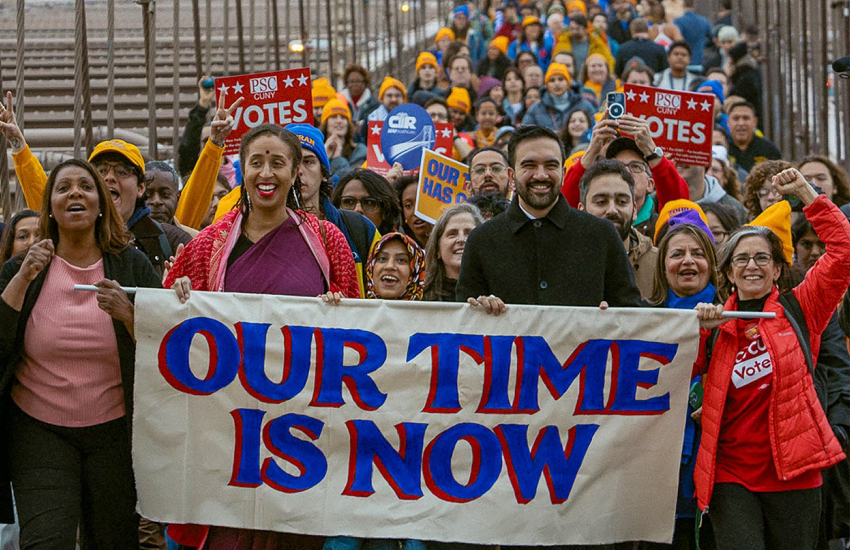
Zohran Mamdani—an intellectual born in Uganda, historian, politician, openly Muslim, and who defines himself as a “democratic socialist”—surprised the United States and the world by winning the mayoralty of New York City.
His victory took place in a metropolis of eight and a half million inhabitants, seen by many as “the capital of the world” and the economic and political center of a global power built by immigrants, yet where 69% of all wealth lies in the hands of the most privileged 10%, beneficiaries of other people’s labor as well as of global domination and exploitation of the world’s peoples.
International media highlighted the event:
In New York, nearly 35% of its 8.5 million residents are migrants. In Queens, however, that percentage rises to almost 50% of its 2.3 million inhabitants. And in neighborhoods such as Jackson Heights, the population of immigrant origin exceeds 60%. Mamdani won there, as well as in parts of Elmhurst and Corona—two other neighborhoods where more than half the population is foreign-born. [1]
The international impact was immediate. The influential Spanish daily El País described the victory as “the first blow to Trump at the ballot box.” Indeed, this result is a strong rebuke to the reactionary and anti-immigrant policies of the current president, who governs with an authoritarian and regressive agenda.
How Did Mamdani Win?
In the most expensive city in the country—and the world—his campaign focused on the issues that most affect working households: cost of living, housing, transportation, and growing poverty. He proposed freezing rents and building 200,000 affordable housing units; implementing a free bus system; creating a network of universal childcare centers funded by the local government; and lowering food costs through public grocery stores. He added a proposal to raise the minimum wage to 30 dollars per hour by 2030, to promote tax reform targeting the ultra-rich and large corporations, and to foster a security model that departs from the NYPD’s traditionally ultra-repressive logic.
One columnist summarized his electoral strategy as follows:
“In his campaign, Mamdani ignored the tired messages of traditional parties, both left and right, which stubbornly deny the increase in cost of living that people see and suffer daily when buying groceries, and he avoided joining the cultural wars that have dominated the last decade.
He rejected the exhausting message of a left intent on reinventing language by imposing the use of ‘they/them’ in everyday speech instead of proposing solutions to reduce the cost of living…”[2]
This message allowed him to channel accumulated social discontent—discontent that in previous years even led young people and wage workers to vote for Trump, believing he could solve the economic crisis. It is no small symbolism that Queens—the immigrant heart of New York and Trump’s own birthplace—is now Mamdani’s stronghold.
Why Did He Really Win?
Mamdani’s triumph was not only due to a skillful campaign or support from sectors of the Democratic Party. Above all, his victory is the result of the accumulated social resistance, mobilization, and struggle of workers and youth seeking real solutions to an increasingly deep crisis.
On one hand, the election reflects exhaustion with the traditional political model and a search for alternatives far removed from the false solutions previously capitalized on by Trump. (See also: “Qué expresa la nueva elección de Trump”)
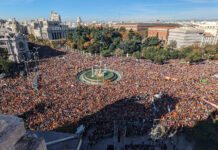
On the other—and more importantly—it is the electoral echo of massive protests against government policies: from the “No Kings Day” demonstrations to the April 5 actions, when more than one million people across all 50 states marched against cuts and attacks on labor rights. These actions even reverberated internationally, with demonstrations in Canada, Europe, and Mexico.
New York—and the United States more broadly—appears to be experiencing an unprecedented wave of mobilization since 2020. In April, 1.1 million protested; in June, four million; in October, seven million. To this we must add widespread rejection of ICE raids and deportations, as well as the militarization of cities driven by the Trump administration.
This climate of discontent found a channel of expression at the ballot box—albeit one with an inevitably distorted political translation.
Rebellion Emerges
Underlying the electoral result is the direct action of masses who, for months, have taken to the streets in huge protests. From the No Kings Day mobilizations to the April 5 demonstrations, thousands of workers marched in a thousand cities across all 50 states—around 1,200 protests in total—under the banner “Hands Off!”, opposing Trump’s cuts and labor attacks. Similar mobilizations echoed in Canada, the United Kingdom, France, Germany, Mexico, and Portugal, highlighting the international character of the backlash. (See also: “No Kings! Trump and His War on Democratic Freedoms.”)
The political situation in New York—and in the United States as a whole—is profoundly shaped by this upsurge of struggle. The No Kings Day protests, along with the massive demonstrations of the Trump era, clearly show this: they are the largest expressions of popular repudiation since the 2017 Women’s March and the 2020 Black Lives Matter protests.
Added to this is the widespread rejection of ICE raids, persecutions, and deportations of immigrants—treated as criminals—as well as the growing militarization of numerous cities. These ultra-reactionary policies ignited various forms of resistance among broad sectors of workers, who strongly oppose the government’s anti-immigrant offensive.
All this accumulated discontent—mass protest, opposition to labor attacks, authoritarianism, and defense of democratic freedoms—finally found, in New York and elsewhere, a channel to express rejection of Trump’s offensive. (See also: “With Trump: Workers Under Attack.”)
A Positive Victory or an Inevitable Disappointment?
Many young people, workers, and activists start from a correct premise: Mamdani’s triumph is politically significant and noteworthy. Because of the city where it occurred and within a national and international context supposedly marked by the “unstoppable” advance of Trump or the “right.”
Unfortunately, they interpret it as an absolute triumph of “progressivism.” They ask: what could be criticized in a politician who promises social concessions, defends Palestine, criticizes Trump, and calls himself a “socialist”? They even compare him with the so-called “left-wing” governments of Latin America, judging them as unquestionable advances of “the people.” With exaggerated electoral confidence, they give full importance to the fact that Mamdani positioned himself as Trump’s “enemy,” and assume his electoral promises—as though already fulfilled—will bring justice to the living conditions of New York’s workers and youth.
Others, however, argue that there is nothing positive in this result. Although somewhat unilaterally, they correctly point out that Mamdani is part of a sector of the Democratic Party—a bourgeois party serving the magnates of the main capitalist power—since he was elected as the candidate of the DSA, the Democratic Socialists of America, a faction of that party. It is neither “socialist” in terms of workers’ interests nor a working-class organization, but rather liberal social-democratic—a project of collaboration between politicians representing different social classes.
They highlight, accurately, that although Mamdani is an immigrant from a modest background and an opponent of Trump and the party elites, he still operates within the framework of the bipartisan system through which the oligarchy rules the United States and the world.
A Contradictory but Politically Significant Phenomenon
From our perspective, the phenomenon must be understood in its entirety, not only through one of its faces. It is contradictory. The fact that New York’s mayoralty is now in the hands of a Muslim immigrant who identifies as a “socialist” is no minor detail within the political process and current struggles in the United States. It is not only novel but highly significant, given its close relationship with the mobilizations confronting Trump.
Although limited by illusions in electoral routes as solutions to urgent needs, the result expresses a shift in the mood of workers seeking alternatives. Contradictory as they may be, these political aspirations represent a positive factor that should be acknowledged—one that could become a lever for advancing struggle.
Rather than focusing solely on the individual political leader and his ties to U.S. business sectors, the deeper drivers of this phenomenon must be examined.
Behind the vote for this candidate are not only illusions, but also the aspirations of people seeking to overcome their distressing daily reality, who reject Trump’s persecutions, want democratic freedoms, and oppose the genocide in Gaza.
Those searching for a different political and social alternative identify with Mamdani’s “socialist” discourse. These aspirations are contradictory but positive, for they emerge from a process of mobilization and struggle in the U.S. and are reinforced by an international context of major movements, strikes, and protests. This is their political value.
The enormous struggles unfolding in the United States signify the beginning of the erosion of the widely resented Trump administration—erosion marked, as noted earlier, by major protests confronting Trump’s authoritarian and regressive advance. This process manifests—though in a distorted way—in Mamdani’s victory. Distorted, because the DSA campaign’s charisma and appealing promises reinforce the harmful notion that collective action may be replaced by the individual act of voting.
Despite what mainstream media and digital platforms say about the virtues of elections as a means to achieve significant changes in living and working conditions, electoral routes tend to divert energies away from the more effective tools of direct, collective struggle. These elections reinforce the liberal-democratic idea that the ballot box is a direct and authentic reflection of social struggle. It is not: the reflection is distorted.
Still, the political mood underlying this election could be used as a lever to push mobilization forward—precisely what Mamdani and his allies hope to avoid. Such aspirations would be invaluable in the hands of a political organization that is not reformist and liberal like Mamdani’s, but genuinely socialist and working-class—one that seeks to continue the mobilization against Trump and to fight for the social demands that Mamdani and his faction will inevitably betray.
The Meeting with Trump: Mamdani’s Limits
It is often said that a picture is worth a thousand words. Ten days after the election, Mamdani proved it. Many of his supporters were stunned by a very cordial meeting between the mayor-elect and President Trump. The New York Times reported:
“What was supposed to be a ‘socialist showdown,’ in the words of a Fox News graphic, instead was filled with smiles, good vibes, and the president’s endorsement of Mamdani’s leadership. ‘I feel very confident he can do a great job,’ Trump told reporters.” [3]
For its part, El País of Spain headlined: “Trump and Mamdani Bury the Hatchet at the White House… President Donald Trump and New York mayor-elect Zohran Mamdani celebrated a meeting on Friday after which they displayed an unexpected harmony in the Oval Office.”
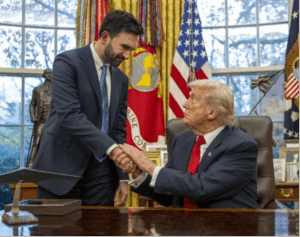
Beyond the multiple justifications that many might offer, and beyond the fact that such cordiality reveals the tricks and half-truths deployed by all bourgeois politicians during campaigns, this surprising rapport between Trump and Mamdani shows that, more than differences, there exists a solid basis for agreement. Both aim to preserve the existing social order and its rules. Both are committed to defending the interests of the same class: the large and small business owners of New York and the country. This is neatly summarized by the statement “we both want what’s best for New York”—meaning the political and financial elite that dominates the city and the nation. They seek to “fix” the system’s problems and relaunch it: to make it great again, as Trump says.
This is also why Mamdani, as former Speaker of the House, defended Democratic Representative Hakeem Jeffries—a staunch supporter of Israel’s genocide in Gaza. And why he will retain Jessica Tisch as the city’s police commissioner, despite her record of “protecting abusive officers at all costs, wearing down families, and delaying or dissolving any disciplinary reforms.” In other words, the brutality and impunity of the NYPD will continue.
All of this—and what is yet to come—stems from the fact that although Mamdani promises social reforms, is an immigrant, Muslim, and supporter of Palestinian rights, he is not a wage worker fighting for working-class causes. He did not win through an independent campaign launched by workers’ organizations but as part of a professional political apparatus within a pro-employer party.
His political program is bourgeois, cross-class, aimed at appealing to immigrant voters of any social class—business owners and workers alike. It is not guided by the needs of the working class, whether immigrant or native. It does not seek to politically break working people away from the two employer parties.
For these reasons, Mamdani represents only the renewed face of the DSA—the Democratic Party’s “left office”—which adopts the label “democratic socialist” while remaining liberal social-democratic. He is far from promoting a break with the imperialist party responsible for supporting genocide in Gaza, for derailing the Black Lives Matter uprising, and for neutralizing the Hands Off and No Kings Day protests, as well as immigrant resistance to Trump’s ICE dragnet.
Thus, the new mayor represents a sector led by Senator Bernie Sanders and Alexandria Ocasio-Cortez within the same establishment party of Biden and Kamala Harris—seeking to defuse street unrest by offering relief or palliative measures to the most painful aspects of daily life for residents of New York City and Queens. Hence his campaign’s invocation of Martin Luther King Jr.: “Call it democracy or call it democratic socialism. There must be a better distribution of wealth for all of God’s children in this country.” His aim is merely to slightly redistribute wealth as a containment wall against rising discontent.
The limitations that will soon lead Mamdani to disappoint workers and youth are considerable. When expectations that his administration will ease the cost of living, transportation issues, and police brutality clash with reality, disillusionment will ensue. His main limits are class-based. Whatever his intentions, he must answer to the bourgeoisie, its institutions, and its rules of the game, which his campaign pledged not to challenge.
What Matters Most: Mobilization
For all these reasons, what ultimately matters is not what Mamdani does or does not do, but the continuity of the protests, discontent, and mobilization that appear to be emerging in the United States. That is where real change may come from.
The burden falls on workers, youth, and political and union organizations to deepen the No Kings mobilizations, strikes, and protests against labor attacks and Trump’s authoritarian agenda—both domestically and internationally against U.S. colonial policies in Latin America and the world. (See also: “The Broadest and Most United Anti-Imperialist Mobilization in Latin America Is Urgently Needed!”)
Only mass struggle—both in the U.S. and throughout our continent—can deliver solutions to the urgent needs of youth, workers, and immigrants, and defend the peoples targeted by U.S. foreign policy. That path is far safer than placing hopes in elections or new candidates, no matter how novel or seemingly disruptive. That is the road needed to surpass Mamdani and the inevitable disappointment his administration will bring to immigrants, workers, youth, and activists. If such a path is taken, it may open the way to building a new working-class, revolutionary socialist organization capable of leading struggles against the system itself—not just its most irritating symptoms.
[1] https://elpais.com/us/2025-11-16/la-esquina-de-queens-que-explica-la-victoria-de-zohran-mamdani-en-nueva-york.html
[2] https://www.eltiempo.com/opinion/columnistas/contra-la-desigualdad-3509614
[3] https://www.nytimes.com/es/2025/11/24/espanol/estados-unidos/trump-mamdani-reunion-reacciones.html