Irene Idris. December 20, 2025
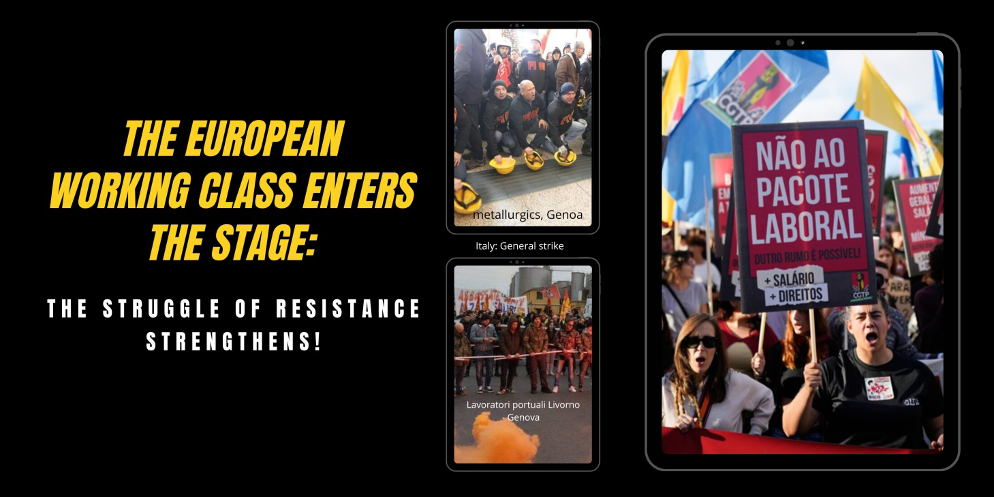
In an international context marked by the economic and political offensive of imperialist governments that threaten workers’ gains and the rights of immigrants, the resistance of workers and oppressed peoples of the world is strengthening with the emergence of the European working class, one of the fundamental battalions in the struggle of the international working class.
They are showing the way to the peoples of Venezuela, Colombia, and Latin America in general to confront the military aggression of the United States, which is besieging the region with its troops in Caribbean territorial waters and imposing economic measures on the government of Nicolás Maduro.
The emergence of the Italian working class, with the general strikes and dockworkers’ boycott in solidarity with the Palestinian people, propelled the massive international movement against genocide. These actions were combined with massive protest demonstrations by sectors of the Spanish population and sectoral production stoppages, along with the support of student youth organized in the Student Union.
These acts of solidarity managed, albeit temporarily, to reduce the devastating bombings and mass killings perpetrated by Zionism and its occupying army in the region.
Currently, another step forward in the resistance process was taken by the workers of Portugal with the General Strike, alongside the metalworkers of Genoa, Italy, who remain on strike today, while the doctors’ strike continues in Spain. Similarly, the organized labor movement mobilized on December 17th in rejection of the «Labor Modernization» project promoted by the government of Javier Milei in Argentina.
All the actions of struggle are to confront the harmful labor reforms, austerity packages and regressive economic measures of their respective governments, which seriously attack their rights and their working and living conditions.
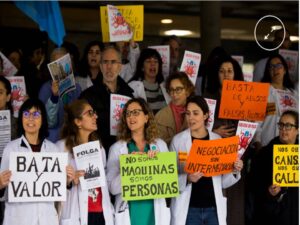
Medical and staff strike at the CHUS (University Hospital Center of Santiago), called by the Omega union. Óscar Corral. Photo source: El País, Spain
***
General Strike in Portugal Against Regressive Labor Reform
“The attack is brutal, the strike is widespread”
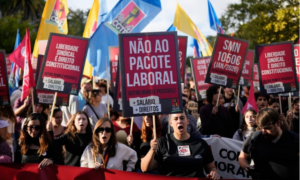
After twelve years, the Portuguese working class once again rose up in a general strike on 11 December against the regressive labour reform and the sweeping economic package that the Social Democratic government intends to impose. The previous general strike had taken place during the administration of then–Prime Minister Pedro Passos Coelho.
For 24 hours, land, maritime, and air transport came to a halt, as did the entire education sector, the health system, communications, and the judicial sector.
According to the newspaper El País: “In maritime transport companies, which employ thousands of workers from the southern bank of the Tagus to access Lisbon, participation was total, as it was in the public railway company Comboios de Portugal and in the airline TAP, where all sectoral unions acted jointly and 220 flights were cancelled. The strike also affected the operations of other companies such as Iberia and Air Europa… the news activity of the public news agency Lusa was also suspended.” [1]
Public opinion, for its part, was largely supportive of the measure: 61% of those surveyed backed the strike, according to a poll published in the Portuguese press.
During the massive demonstration that accompanied the strike, slogans were chanted such as: “The attack is brutal, the strike is general,” “We will not surrender, the economic package must fall,” “The labour package is dictated by the bosses,” and “Poverty wages, rising rents! The people can take no more; it is time to act.[2]
***
Genoa metalworkers’ strike:
«All together, united in the struggle, I’ll be here with you all week!»
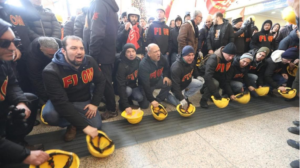
Metalworkers in Genoa are on strike to defend their jobs. Through pickets, demonstrations, and road blockades, they are demanding that the government halt the plan to close the historic ILVA steel plants in Italy, the largest steelmaker in Europe, and allocate the necessary resources to guarantee continued production and jobs.
According to the general secretary of the UILM union, Rocco Palombella, the government’s plan is brutal: «It’s a death plan. Starting March 1st, all the factories will close. They have made it clear that they will not back down.» “We are at our limit.” [3]
In this regard, Armando Palombo, a union representative from Acerías de Italia, stated: “I have worked at ILVA for 36 years, and for the last twelve years I have witnessed the ongoing process of plant shutdowns. We are confined to our homes, not knowing what is happening. The process was interrupted, annulled, suspended… due to a procedural flaw. Now there is a new process, and we can’t take it anymore.”
Meanwhile, a worker declared during the protest, as the march stopped at the Brignole train station: “Four days of striking have cost us 480 euros. We workers know this, but the students, rightly so, have supported us. This is what life in the factory is all about.”
Shouting “Work, work, work! We are workers, we will not back down, arrest us all! We defend our jobs with the strike!” the workers carried out the mobilization and stood before the police.[4]
“All together, united in the struggle,
I spend the whole week here with you.
We won’t give up even though there’s no pay,
only this rage growing inside me.”Link to the video of the metalworkers’ protest in Genoa:
***
General Strike Against the Budget Law and Meloni’s Labor Reform: Says “No to Rearmament”
On December 12, the Italian working class, called by the Italian General Confederation of Labour (CGIL)—the country’s main trade union—held a national strike against the Budget Law and the pro-business labor reform promoted by the government of Giorgia Meloni. According to press reports, the strike partially paralyzed urban and rail transport, and also led to the closure of schools in various regions of the country.
“No to Rearmament!”
The working class says “No to Rearmament!” and demands that the enormous budget allocated to Defense be redirected toward investments in health, education, and public services, as well as addressing labor demands. Likewise, the demonstrators rejected the increase in the retirement age and the labor reform that only benefits employers. As one union leader put it:
“The only public spending our country is planning is rearmament,” the union leader stated, denouncing the “absurd logic of states increasing arms spending when workers can’t make ends meet, wages are low, and the purchasing power of employees and pensioners is being cut.” [5]
***
«The workers’ struggle in Italy and the struggle for the freedom of the Palestinian people are one and the same battle.»
National General Strike in Italy in solidarity with the Palestinian people.
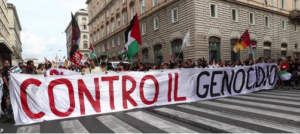
The Italian working class, organized in its grassroots unions—teachers, metalworkers, dockworkers, among others—brought their labors to a standstill, leading massive general strikes and national mobilizations in solidarity with the Palestinian people in Gaza, rejecting the support for genocide by the government of Giorgia Meloni, and demanding the suspension of Italy’s trade relations with Israel.
«An unprecedented mobilization.»
The massive march called by the unions, which marked the beginning of the strike, brought together nearly 300,000 demonstrators in Rome. The USB organizers praised the strength of the demonstration: «We are talking about some 300,000 people just in the part of the march that we organized,» they declared. [6]
According to the unions, «This mobilization represents a historic step in the capacity of the popular movement to unite the social struggle in Italy with international solidarity.»
For their part, the dockworkers in Livorno, upon declaring their strike on September 29, 2025, stated:
the need to abstain from all loading, unloading, and storage operations related to the Israeli state economy. For these reasons, the Livorno branch of Filt CGIL has officially announced the suspension of the cooling-off clauses and the call for a strike for all port operations related to this traffic, effective today (the arrival of the Israeli company’s ship, the Zim Virginia, is scheduled). [7]
This determination to boycott Israel led the dockworkers to force the Israeli vessel ZIM Virginia to withdraw from the port.
Similarly, under the slogan «dockworkers don’t work for war,» delegations of dockworkers from Spain, France, Greece, Cyprus, Morocco, Germany, and the United States, convened by the Genoa dockworkers’ union affiliated with the USB, met to coordinate joint actions to boycott Israel, in solidarity with Gaza, and in rejection of the genocide perpetrated by Israel.
The dockworkers’ joint declaration emphasized that «dockworkers don’t work for war.»
«We don’t want our ports, our workers, or ourselves to carry weapons or bombs to massacre people. We don’t want governments or the European Union to turn the economy into a war machine. Why privatize the ports and cut wages? Why deprive people of a dignified life? We don’t want to contribute to the thousands of euros this war machine costs. With this declaration, we confirm that we are against this imperialist war and demand:
-
An end to the genocide of the Palestinian people.» Israel is acting as a murderous state with the support of the US, NATO, and the European Union.
-
The immediate opening of humanitarian corridors for the Palestinian people who are currently suffering from hunger.
-
We want our ports to contribute to the delivery of aid and peacekeeping troops.
- We are against Europe’s military armament program, which should be directed toward people, wages, and social security.[8]
With political strikes like these and other solidarity actions led by the Italian working class, followed by the Spanish working class, workers’ internationalism and class solidarity, as historical foundations of the labor movement, were indeed revived. In this way, the working class, and also broad sectors of the youth, realized that the power capable of stopping Zionist barbarism lies in the hands of the working class itself and its allies in their collective action and mobilization.
***
In Greece, the working class says ENOUGH! to the Labor Reform
“No to 13 hours of slavery”
Public sector workers in Greece held a 24-hour strike on October 14 against the government’s proposed law that aims to extend the workday to 13 hours.
According to an article in the newspaper El Tiempo: “The 24-hour strike, called by ADEDY, Greece’s main public sector union, left the entire country without intercity train services on Tuesday, while passenger ferry services were also suspended, as the maritime unions joined the strike.” [9]
Regarding this, one protester stated: “This law is just one part of a concrete policy that destroys collective labor rights… We have an increase in violence and crime in schools, which we now expect to increase even more because parents literally won’t be able to see their children with this law,” Spiros Vettas, a secondary school teacher, told EFE during the Athens protest.[10]
The Unity of the Working Class Is Essential
[1] Tereixa Constenla. El País, Lisboa – 11 Dic 2025
[2] Domingos Mossela. https://aimnews.org/. 2025-12-12
[3] La Milano. Chiara Sutermeister. 19 noviembre 2025
[4] https://www.instagram.com/reel/DR-KpJDCK1x/
[5] https://www.usb.it/ . 15/10/2025.
[7] Manuel Ribeiro. Euronews. 27/09/2025 .
[8] https://www.eltiempo.com/mundo/europa/grecia-paralizada-por-huelga-general-de-los-trabajadores-del-transporte-publico-contra-proyecto-que-busca-instaurar-jornada-laboral-de-13-horas-3499545
[9] Idemn